


- Day on the Hill Booklet (PDF)
- Day on the Hill Booklet (Word)
- Day on the Hill Booklet (Large Print)
- Day on the Hill Booklet (plain text)
- Day on the Hill Booklet (Audio)
Reminder: Use the language translation plugin at the top of this website to translate any page. If you need a language that is not listed, please contact eleanor@ncil.org.
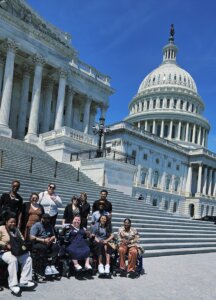
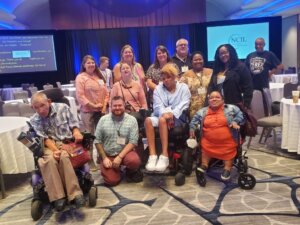
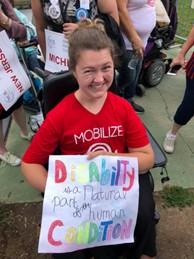
Each July, on the Anniversary of the ADA, people with disabilities and our allies from across the nation travel to Washington, DC to meet with our legislators to discuss our most pressing concerns.
Introduction
The deinstitutionalization movement, which began in earnest in the 1960s and 1970s, marked a significant turning point in how society viewed and treated people with disabilities. Historically, individuals with disabilities were often segregated and warehoused in large, state-run institutions — places that frequently denied them basic rights, autonomy, dignity, and meaningful community participation. Activists and allies, including disabled people themselves, exposed the inhumane conditions within these institutions and challenged the prevailing belief that people with disabilities could not live independently.
As momentum for deinstitutionalization grew, it became increasingly clear that simply moving people out of institutions was not enough. The disability rights movement emerged alongside deinstitutionalization, demanding equal rights, self-determination, and full participation in all aspects of society.
This push led to the creation of the Independent Living movement, championed by leaders like Ed Roberts and Judy Heumann, who insisted that people with disabilities should have the same opportunities as everyone else to choose where and how they live, work, and participate in their communities.
Centers for Independent Living (CILs), founded by and for people with disabilities, became key vehicles for this innovative approach. CILs provide peer support, advocacy, and services that empower individuals to make their own choices and live independently, reflecting the core values of dignity, autonomy, and inclusion.
Deinstitutionalization, therefore, not only challenged the physical walls that confined disabled people but also ignited a broader movement that continues to shape disability policy and practice today.
Yet, as funding for community-based services remains under threat and program infrastructures fray, many people with disabilities continue to face the risk and the reality of re-institutionalization, underscoring the urgent need to protect and expand the promise of community integration.
This year, NCIL’s primary focus for our Day on the Hill is protecting the infrastructure and funding for programs that help keep people in their homes and community – and out of institutions. We will not go back.
2026 Health and Human Services Budget
The 2026 President’s proposed budget outlined significant cuts to many disability programs and proposed the elimination of the Administration for Community Living (ACL). As of June 30, 2025, here is what we know so far:
On March 27, 2025, the Department of Health and Human Services (HHS) announced that it will be restructured; that the Administration for Community Living would be eliminated; and that the programs currently administered by ACL would be relocated to other departments within HHS.
It was later announced that ACL programs would be moved together; that they would be located within the Administration for Children and Families; and the department would be renamed the Administration for Children, Families and Communities. Twenty state Attorneys General filed a lawsuit regarding the HHS reorganization and the reduction in force of HHS employees. There is currently a court-issued injunction, which places the reorganization on hold.
The FY 2026 budget justification for HHS proposes to keep funding at current amounts for grants to Centers for Independent Living (CILs), known as Part C funds. The justification also proposes to increase Independent Living State Grants, known as Part B funds, which fund some CILs and Statewide Independent Living Councils (SILCs).
The proposed increase of $100 million comes with a caveat: at the state’s discretion, expanded funding could be used to continue the activities currently provided by the programs that were eliminated in the budget, including the University Centers for Excellence in Developmental Disabilities, Developmental Disabilities Projects of National Significance, the Limb Loss Resource Center, the Paralysis Resource Center, and provision of Voting Access for People with Disabilities.
NCIL is urging Congress to use its oversight authority to ensure that the framework and infrastructure outlined for the administration of our programs in federal statute is protected; and for appropriations that allow the Independent Living Program and our partners under the Administration on Disability to continue working to advance community living for disabled people.
NCIL has been clear that the Independent Living Program needs an increase in federal funding to properly support a nationwide network of over 400 CILs and 56 SILCs, and to serve people of all disabilities across the lifespan. However, it is vitally important that congress preserves and funds the existing AOD programs within their current budget line items.
We are advocating to protect the infrastructure and network of programs that work in collaboration to advance community living.
The Independent Living Program
Protecting and advocating for increased funding for the Independent Living Program is always NCIL’s number one priority.
Centers for Independent Living have been underfunded for decades, leading to individuals with disabilities lacking access to critical services and supports! Many areas in the U.S., especially rural communities, do not have access to a CIL. CILs need more funding to best serve their existing service areas, address unmet needs, and expand their service areas where IL services are currently unavailable.
The Independent Living Network consists of 367 Centers for Independent Living that receive federal funding, dozens of CILs that receive only state funding, and 56 SILCs throughout the United States. According to the most recent State Plans for Independent Living, the IL Network covers 2,475 counties and county equivalents across the U.S. and its territories, which represents services to about 80% of the population.
For the last three years, we have asked for an increase to $500 million to support the network of Independent Living Programs. Currently, Independent Living is funded at $128 million. We continue to advocate that the need is $500 million. However, recognizing the current federal climate, we formally requested a 10% increase for FY 2026 appropriations. The need and goal of $500 million to support our network remains.
What is Independent Living?
A movement, a philosophy, and specific programs led by people with disabilities that provide advocacy, tools, resources, and support for integrating people with disabilities into their communities to promote equal opportunities, self-determination, and respect. All people can:
- Live with dignity,
- Make their own choices, and
- Participate fully in society.
Why Community Living?
- People prefer to live in their own homes.
- It is a legal right.
- It costs less.
- Everyone benefits when everyone can contribute.
Centers for Independent Living (CILs)
CILs are hubs of disability information, resources, services, and advocacy. CILs have a unique ability to creatively address barriers within their individual communities, allowing the Independent Living Network to respond quickly and effectively in times of crisis and emergency. Investing in CILs benefits the entire community and yields a strong return for taxpayers. Federally funded CILs provide five core services:

Statewide Independent Living Councils (SILCs)
Statewide Independent Living Councils (SILCs) are governor-appointed entities that are comprised of a majority of individuals with disabilities in each state and territory. A SILC’s work includes the development of the State Plan for Independent Living (SPIL), which is the state’s three-year strategic roadmap for executing, expanding, and improving independent living services and reducing the barriers to community living for individuals with disabilities.
Legal Foundation, Funding, and Oversight
Founding Document: Title VII, Rehabilitation Act of 1973, as amended.
There are two types of CIL funding:
- Subchapter B – Independent Living Services
- Subchapter C – Centers for Independent Living.
The Office of Independent Living Programs (OILP) within the Administration for Community Living (ACL) in the Department of Health and Human Services (HHS) is tasked with overseeing the Independent Living Program at the national level.
Supporting our Administration on Disability Partners
Protection and Advocacy (P&A) System and Client Assistance Program
The Protection and Advocacy for Individual Rights (PAIR) and Client Assistance Program (CAP) are essential safeguards for the rights of people with disabilities. P&A systems, authorized under the Developmental Disabilities Act, investigate abuse and neglect, protect against discrimination, and ensure access to education, healthcare, housing, and employment. The PAIR program assists adults and children with mobility, sensory, physical, and other non-developmental or non-mental health disabilities, including conditions such as cancer and diabetes.
CAP helps individuals understand and exercise their rights under the Rehabilitation Act, particularly in navigating Vocational Rehabilitation and Independent Living services. Together, these programs serve as a critical check on systemic barriers and individual injustices, often intervening where no other support exists.
Appropriations Asks:
- CAP: $16 million
- PAIR: $25 million
Protection & Advocacy for Voting Accessibility (PAVA)
Through Protection and Advocacy for Voting Accessibility (PAVA) funding, the nationwide network of P&A agencies helps ensure the full participation of citizens with disabilities in the entire electoral process, including registering to vote, casting a ballot, and accessing polling places. The PAVA program empowers voters with disabilities and local election officials, eliminates unnecessary barriers, and strengthens public confidence in our electoral system.
Discontinuing PAVA funding would not only jeopardize the ability for over 40 million citizens with disabilities to independently mark, cast, and verify their ballots, but would also place added burdens on state and local officials, reduce civic engagement, and undermine decades of bipartisan efforts to improve election accessibility.
- Appropriations Ask: $13 million
University Centers for Excellence in Developmental Disabilities
UCEDDs create and use proven strategies, train professionals who work with people with disabilities, and work with governments and communities to improve policies and systems. UCEDDs are programs approved by Congress and have had strong support from both political parties for over 60 years. They are trusted organizations that connect research, training, and community services to help people with developmental disabilities at all stages of life. If UCEDDs were eliminated, it would break apart important support systems in each state and undo decades of progress in areas like early help for children, inclusive schools, fair access to healthcare, and job training. Without UCEDDs, people with disabilities, their families, government agencies, and service providers would lose access to a vital program that delivers important research, services, and training. Last year alone, UCEDDs trained over 620,000 people, about 9,250 per center and more than 10,000 per state. They also provided services to more than 1.3 million people, nearly 20,000 individuals per center.
- Appropriations Ask: $43.1 million
Developmental Disabilities Councils
DD Councils are governor-appointed bodies that operate in every U.S. state and territory. Funded through state formula grants, DD Councils identify and address systemic barriers through advocacy, capacity building, and systems change activities. Councils invest in grassroots leadership, pilot innovative approaches, and influence policy to improve services and create more opportunities for people with developmental disabilities and their families. Councils work at the local and state level and are deeply embedded in their communities.
- Appropriations Ask: $85 million
Limb Loss Resource Center
The Limb Loss Resource Center provides education, peer support, workforce transition support, and healthcare navigation for veterans and civilians who are at risk of or have had an amputation and those born with limb differences. The program collaborates with over 155 hospitals across the U.S. to ensure that support services and educational resources are available to individuals, their families, and caregivers before and after amputation, and to parents when a child is born with a limb difference. With over 1500 active volunteers and 189 community-based support groups connected through the network, the program, which has been federally funded since 1997, has supported the creation of an infrastructure that optimizes every dollar for efficiency and effectiveness. The elimination of this program would severely deteriorate the support services available to the over 5.6 million individuals living with limb loss or limb difference in the U.S.
- Appropriations Ask: $4.2 million
Paralysis Resource Center
The Paralysis Resource Center works with individuals, caregivers and military veterans impacted by paralysis, including access to rehabilitation, equipment, peer mentoring, and a range of other vital services and supports. The Paralysis Resource Center also directs funds to organizations providing direct services to communities across the country.
- Appropriations Ask: $10.7 million
Contact + Additional Priorities
Additional legislative priorities and policy positions from NCIL are available at www.ncil.org.
If you have any questions, please contact NCIL’s Director of Advocacy and Public Policy Jessica Podesva, J.D. at jessica@ncil.org.
