2026 Annual Conference on Independent Living
July 20-23, 2026
Grand Hyatt, Washington, DC
Presented by the National Council on Independent Living
Advocate’s Guide to the Hill
Before the Visit
1. Call or email the legislator’s office to ask for an appointment.
If the legislator is unable to meet, ask to meet with their staff person handling the issue. The best opportunity to set up a meeting is during a legislative recess if you are meeting in a district office.
2. Make an appointment
- State the name and / or number of the bill or issue and your position.
- State your attendees’ names, addresses, and affiliations. Notify the office in advance of any changes in this list.
- Confirm the meeting date, time, attendees, purpose, and background in writing.
3. Prepare for the meeting
- Plan for the meeting to last 15-30 minutes.
- Develop a one-page position paper and make copies to distribute at your meeting.
- Educate yourself about the official — their background, political philosophy, and the number of community associations in their district.
- Consider what questions may be asked and develop answers to those questions.
4. Be flexible.
Legislators’ schedules often change due to urgent meetings, hearings, or votes, so your meeting may be canceled or delayed. You can always ask to meet with a staff person responsible for the issue.
During the Visit
1. Arrive 5-10 minutes before the meeting.
2. Briefly introduce yourself and other attendees.
- Let the legislator know how many individuals reside in your association.
- Mention that you are a constituent or introduce constituents in your group.
3. Clearly explain your issue.
- Use layperson’s terms.
- Use personal experiences to describe how the issue affects you or your community. Share your story or have a constituent share their story.
- Do not read from your position paper.
4. Ask if the official has any questions. Then ask directly for their or her support.
- Pay attention to the response. He or she might be talking with several groups about the issue to determine their position.
- Never argue or act combative with the legislator or staff person.
5. At the end of the meeting, be gracious and thank the legislator or staff member for his or her time.
- Sum up any commitments made by the legislator.
- Offer to provide further information or a meeting with other residents.
- Leave your leave-behinds.
After the Visit
1. Share a picture or positive note on social media. Tag the legislator and provide an image description.
- Write a personal thank you note to the legislator and any staff with whom you met. Briefly restate your position and include any additional information that may have been requested. Provide a summary of your understanding of the outcome of the meeting.
- Maintain contact with the legislator as the issue progresses. Continue to provide feedback or input to remind the legislator or staff person of your ongoing interest in the issue.
About Your Visit to Capitol Hill
Getting to the Capitol
Directions from the Grand Hyatt Hotel to Area 12, next to the Capitol Reflecting Pool:
- Depart 11th & G Streets NW.
- Travel 2 blocks east on G St. NW.
- Turn right on 9th St. NW and travel 3 blocks south.
- Turn left on Pennsylvania Ave. NW and travel 4 blocks southeast.
- Proceed to Area 12 of the Capitol Grounds, immediately north of the Capitol Reflecting Pool.
The metro stations at Union Station and South Capitol are located just a few blocks away from the House and Senate Office Buildings. Union Station is to the north, closest to the Senate Office Buildings. Capitol South is located to the south, closest to the House Office Buildings.
Cabs are also readily available near the U.S. Capitol. A limited amount of wheelchair-accessible Uber vans are also available in DC. For more information: www.uber.com/ride/uberwav.
Security and Entrance Information
To meet with your elected official, you will have to pass through security screening in all House and Senate Office Buildings. You are encouraged to bring a photo ID with you on your Capitol Hill visit.
If you are escorted through the tunnels between the House and Senate sides of Capitol Hill, you will be required to have a REAL ID or equivalent, such as a passport.
You will be required to pass through a body scanner. If you are unable to be scanned or are uncomfortable, please request a pat-down or wand screening. All bags are subject to thorough search and security screening. If you have any of the following items with you, you may not be allowed to visit your Representative. This is an abbreviated list. If in doubt, leave it at the hotel!
- Signs
- Mace and pepper spray
- Any sharp or pointed object
- Cans and bottles
- Weapons of any kind
- Non-aerosol spray
- Aerosol containers
- Knives of any size, including pocketknives
- Any bag larger than 14″ wide x 13″ high x 4″ deep (per security discretion)
Tunnels
Both the Senate and the House Office Buildings are connected by underground tunnels. Once you pass through security to either the Senate or the House Office Buildings, you can move about freely between buildings of that side without having to repeatedly go through security. The interconnecting tunnels can be found in the basements of both the Senate and House Office Buildings.
To get from either the House Office Buildings to Senate Office Buildings or from Senate Office Buildings to House Office Buildings, you will need an escort from a staff member. Please note that you will also be required to show a REAL ID or equivalent, such as a passport.
Directories of the 119th Congress: Second Session
Directory of the Senate: To contact your Senator, use the directory at: www.senate.gov/senators/contact. Senators are listed alphabetically with their phone numbers, email addresses, and office locations available. You may also find information by calling the Capitol Switchboard at 202-225-3121 or 202-224-3091 (TTY).
Your Senator’s office will be in one of three “Senate Office Buildings” or SOB. They are Dirksen, Hart, and Russell. The room number of your Senator coincides with the floor his or her office is on. If your Senator is located in Hart 302, that office is on the 3rd floor; Dirksen 439 is on the 4th floor; Russell 238 is on the 2nd floor.
Directory of the House of Representatives: To contact your Representative, use the directory at: www.house.gov/representatives. Representatives are listed alphabetically with their phone numbers, email addresses, and office locations available. You may also find information by calling the Capitol Switchboard at 202-225-3121 or 202-224-3091 (TTY).
Your Representative’s office will be in one of three “House Office Buildings” or HOB. They are Cannon (CHOB), Longworth (LHOB), and Rayburn (RHOB). The room number of your Representative coincides with the floor his or her office is on. If your Representative is at Cannon 328, that office is on the 3rd floor. If the office number is more than three digits, disregard the first number and the second number represents the floor your Representative’s office is located on. For example, an office listed as Rayburn 2439 is on the 4th floor and Longworth 1721 is on the 7th floor.
Hill Cafeterias
Have some downtime between appointments once you are in the House or Senate Office Buildings? Both offer places to have everything from a quick snack to a full meal. For more specific information on directions to tunnels, eateries, or your legislator’s office, feel free to ask Hill staff or security.
Senate Office Buildings:
- Russell Basement: Coffee and Sandwich Shop
- Dirksen Basement: Full Cafeteria – Your best bet on the Hill!
House Office Buildings:
- Longworth Basement: Cafeteria
- Rayburn Basement: Coffee and Sandwich Shop
There is also a cafeteria located inside the U.S. Capitol Building.
Services on Hill Visits
Congress is responsible for providing interpreters for Hill Visits upon request. The following email contact is provided by the Capitol Visitor Center: interpreters@saa.senate.gov. For more help with planning your visit to the Capitol, please visit the Capitol Visitor Center’s website: visitthecapitol.gov/plan-visit/visitors-disabilities.
Accessible Entrances
Capitol Building: Public tours enter through the Capitol Visitor Center; official House business enters on the south side of the Capitol; official Senate business enters on the north side of the Capitol.
Capitol Visitor Center (CVC): Main entrance at First and East Capitol streets. The CVC also offers an on-demand shuttle and other services.
Cannon House Office Building: Entrance on New Jersey Avenue, SE, south of the terrace at the intersection with Independence Avenue.
Dirksen Senate Office Building: First and C Street entrance.
Ford House Office Building: Entrance on 3rd Street, SW or 2nd Street, SW.
Hart Senate Office Building: Second Street entrance or Constitution Avenue entrance.
Longworth House Office Building: Main entrance at Independence and New Jersey Avenues, or the South Capitol Street entrance.
O’Neill House Office Building: C Street SW between 2nd and 3rd Streets.
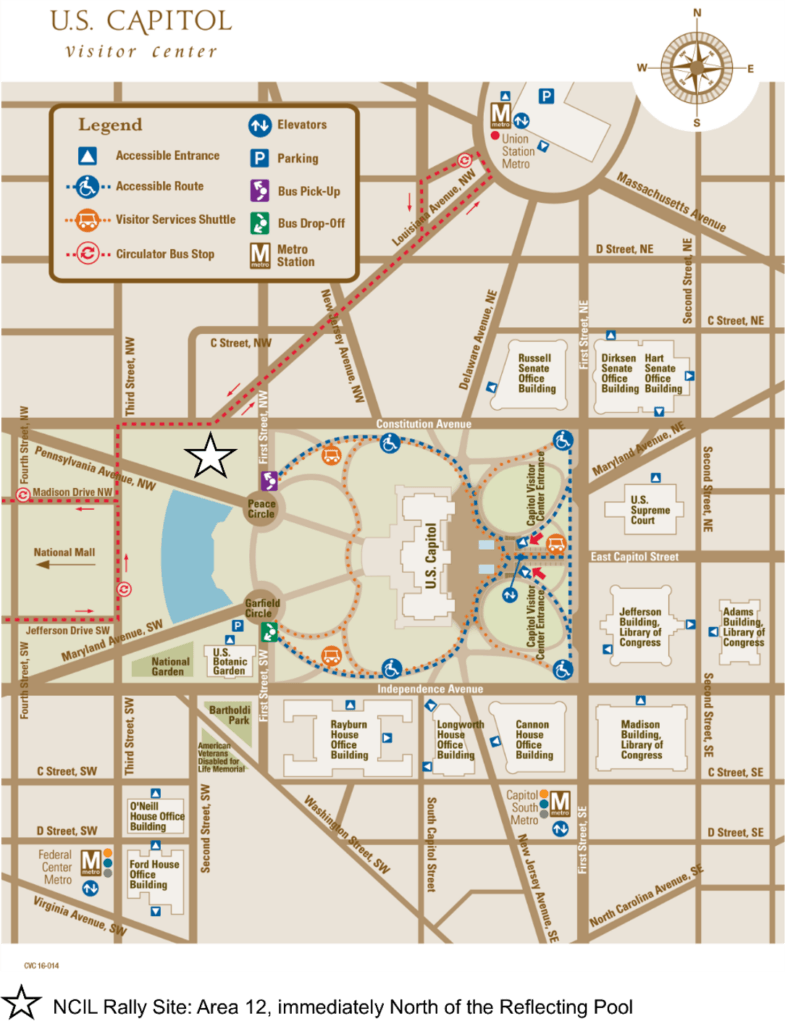
Map of Capitol Hill
Written Description of Map
Dirksen Senate Office Building: Northeast of the Capitol, adjoining the Hart Senate Office Building on a site bounded by Constitution Avenue, Second Street, First Street, and C Street, N.E.
Russell Senate Office Building: Northeast of the Capitol on a site bounded by Constitution Avenue, First Street, Delaware Avenue, and C Street, N.E.
Hart Senate Office Building: Northeast of the Capitol, adjoining the Dirksen Senate Office Building on a site bounded by Constitution Avenue, Second Street, First Street, and C Street, N.E.
Cannon House Office Building: Southeast of the Capitol on a site bounded by Independence Avenue, First Street, New Jersey Avenue, and C Street S.E.
Longworth House Office Building: South of the Capitol on a site bounded by Independence Avenue, New Jersey Avenue, South Capitol Street, and C Street, S.E.
Rayburn House Office Building: Southwest of the Capitol on a site bounded by Independence Avenue, South Capitol Street, First Street, and C Street, S.W.