2026 Annual Conference on Independent Living
July 20-23, 2026
Grand Hyatt, Washington, DC
Presented by the National Council on Independent Living
Workshops
About Workshop Sessions
Workshops are classified by target audience:
- Frontline staff & consumers
- Advocates & project directors
- Executive directors & board members
Workshops are also classified by experience level:
- Newcomer
- Experienced
- Appropriate for all knowledge levels
Workshop Tracks
Building Resilient Organizations: This track focuses on strengthening the foundation of your organization for long-term success. It will help you ensure your CIL or SILC can adapt, withstand, and thrive in the face of challenges, uncertainty, and change.
Empowered to Lead: This track is dedicated to developing strong, inclusive leadership at every level. This track focuses on cultivating the next generation of leaders within your organization and community.
Advocacy in Action: The demand for disability advocacy has never been higher. Join our advocacy track workshops to grow your skills and work on the top advocacy issues facing Independent Living across the country.
Strengthening Connections – Community and Peer Networks: This track focuses on the power of relationships to drive change. It will give you tactics to help you improve partnerships, grow networks, and increase overall impact through community engagement.
Concurrent Workshops 1: Monday, July 20; 10:00-11:15 a.m.
1.1 Expanding Our Movement: Ensuring Independent Living Access for (Im)migrant Communities
- Track: Strengthening Connections — Community and Peer Networks
- Target Audience: Appropriate for all audiences.
- Knowledge Level: Appropriate for all knowledge levels.
- Location: Lafayette / Farragut
(Im)migrants and refugees with disabilities face unique barriers to accessing Independent Living services, including language access, fear of immigration enforcement, documentation requirements, transportation barriers, and lack of culturally responsive outreach. This session explores how CILs can strengthen access through community partnerships, trauma-informed and culturally competent practices, and targeted advocacy. Participants will learn actionable strategies to build trust, improve outreach and create inclusive systems that better support (im)migrant communities with disabilities. Interactive discussion and practical tools will be shared.
Presenters
Maria Stepanyan brings over a decade of experience in nonprofit leadership, strategic development, and change implementation. Since 2010, she has focused on advancing independence and equity for individuals with disabilities in the United States. Prior to that, she worked with children with disabilities in Russia. Maria holds a degree from the Moscow Financial College and is a graduate of the Leadership Academy program at Georgetown University. Fluent in Armenian, Russian, and English, Maria brings a global perspective shaped by her diverse work and life experiences in Armenia, Russia, and the United States. Committed to promoting intersectionality and inclusion, Maria is passionate about fostering sustainable growth, empowering teams, and creating opportunities for individuals with disabilities to achieve independence and a high quality of life.
Elham Youssefian joined International Refugee Assistance Project (IRAP) as director of Disability Inclusion and Accessibility in March 2024. Her role is to lead IRAP’s transition to a more disability-inclusive and accessible organization both internally and externally. Her mission is to promote equal access to safety and protection, and meaningful participation for refugees and other displaced persons with disabilities. Elham is a blind human rights lawyer born and raised in Iran. Before joining IRAP, Elham was working with the International Disability Alliance, a global network of organizations of persons with disabilities, as the senior adviser on humanitarian, disaster risk reduction, and climate action. Prior to that, Elham did extensive research and advocacy on human rights of persons with disabilities in Iran. In 2015, she also worked as protection officer with Danish Refugee Council office in Iran, serving Afghan refugees in the country. Elham holds a Master of Human Rights Law from the London School of Economics.
Craig Towler is a dedicated disability rights advocate focused on dismantling barriers and advancing meaningful policy change that improves the lives of people with disabilities. As the Director of Public Policy and Advocacy at the Center for People With Disabilities (CPWD), Craig leads advocacy efforts centered on equity, accessibility, and community inclusion. He regularly collaborates with consumers, community partners, and advocates to ensure policy reflects the lived experiences of the disability community. In 2024, Craig served on the Governor’s Task Force Related to the Rights of Coloradans with Disabilities – Government Subcommittee, and is currently on the Board of Directors for Disability Law Colorado, and on the Move United Access and Opportunity Advisory Council. Through this work, Craig is committed to elevating lived experience as expertise and ensuring people with disabilities have a seat at the table.
Slide Deck
>> SLIDE 1
Expanding Our Movement: Ensuring Independent Living Access for (Im)migrant Communities
July 20, 2026
Maria Stepanyan Elham Youssefian
Kelsey Bell
Craig Towler
>> SLIDE 2
Workshop Purpose
- Explore the intersection of disability and (im)migration within the Independent Living movement.
- Understand systemic, cultural, and practical barriers faced by immigrants and refugees with disabilities.
- Identify strategies to improve outreach, trust, inclusion, and access to services.
>> SLIDE 3
Core Workshop Goals
- Identify at least three systemic barriers (im)migrants with disabilities face in accessing IL services.
- Understand how (im)migration systems and disability systems intersect.
- Learn practical outreach and partnership strategies.
- Leave with at least one actionable idea participants can implement.
>> SLIDE 4
Why This Matters Now
(Im)migrants and refugees with disabilities often face overlapping barriers.
- Fear, language access, documentation concerns, and lack of culturally responsive services limit access.
- CILs have a critical role in advancing equity and inclusion.
>> SLIDE 5
Opening Reflection Question
- What barriers might prevent an (im)migrant with a disability from accessing independent living services?
- How can organizations unintentionally create barriers?
>> SLIDE 6
Panelists
Elham Youssefian
Director of Disability Inclusion and Accessibility
The International Refugee Assistance Project
Logo featuring bold white letters “IRAP” above smaller white text “International Refugee Assistance Project” on a dark blue background. The design represents an organization focused on providing legal aid and support to refugees.
>> SLIDE 7
Panelists
Maria Stepanyan Executive Director
Center for People With Disabilities
Craig Towler
Director of Public Policy and Advocacy
Center for People With Disabilities
Logo featuring stylized figures representing people with various disabilities, including wheelchair users and individuals with crutches, above bold yellow letters “CPWD.” Text “Center for People With Disabilities” curves below a blue oval, emphasizing support and inclusion for people with disabilities.
>> SLIDE 8
Panelists
Kelsey Bell
Executive Director
Southwest Center for Independence
>> SLIDE 9
Understanding the Barriers
Who Are We Talking About?
(Im)migrant – a person who comes to live permanently in a foreign country (first generation, 1.5, or second generation) Includes other terms and categories such as:
- New Americans
- Naturalized Citizens
- Permanent Residents (PR)
- Refugees
- Asylees
- Migrants
- Twilight Status (DACA, TPS)
- Unauthorized/Undocumented
>> SLIDE 10
Understanding the Barriers
Who Are We Talking About?
Each category has different experiences, barriers, and opportunities. May also be described as:
- First generation (foreign born)
- Second generation (native-born with at least one immigrant parent), 1.5 generation (likely immigrated with parents as children or teens)
>> SLIDE 11
Understanding the Barriers
More than three-quarters of (im)migrants are in the United States lawfully, as:
- Naturalized citizens
- Legal permanent residents (aka green-card holders)
- Refugees and asylees, or
- Individuals on long-term temporary (aka nonimmigrant) visas
>> SLIDE 12
Understanding the Barriers
According to Pew Research Center, the foreign-born population in the U.S.A, 2022 includes
- 49% (23.4 million) naturalized citizens
- 24% (11.5 million) LPRs
- 23% (11.0 million) Unauthorized immigrants
- 4% (2.0 million) Temporary lawful residents
>> SLIDE 13
Systemic Barriers
- Eligibility restrictions and documentation requirements
- Public charge fears and misinformation
- Complex service systems and navigation challenges
- Limited accessibility in (im)migration-related systems
>> SLIDE 14
Community-Level Barriers
- Language access limitations
- Lack of trust in institutions
- Cultural stigma surrounding disability
- Limited awareness of IL services
>> SLIDE 15
Panelist Questions
What are some of the biggest barriers (im)migrants with disabilities face when trying to access services or supports?
Can you share an example or story that illustrates the challenges families or individuals face?
From your experience serving rural communities, what barriers make it difficult for people with disabilities to access services, and how might those challenges be even greater for (im)migrants or refugees living in rural areas?
>> SLIDE 16
Strengthening Connections & Partnerships
- Building trust through consistency and cultural responsiveness
- Meeting communities where they are
- Centering lived experience in outreach and planning
>> SLIDE 17
Peer Engagement Strategies
- Use peer navigators and community ambassadors
- Offer workshops in trusted community spaces
- Build long-term relationships, not one-time outreach
>> SLIDE 18
Panelist Questions
What are effective ways organizations can begin building trust with (im)migrant communities?
What makes a partnership with an (im)migrant-serving organization successful?
Trust is often a key factor in whether people seek services. What have you learned about building trust with underserved communities in rural areas, and how might those lessons apply when working with (im)migrant communities?
>> SLIDE 19
Panelist Questions
How can CILs better meet communities where they already are instead of expecting communities to come to them?
What outreach strategies have actually worked well in your experience?
>> SLIDE 20
Audience Engagement
Raise your hand if your organization currently partners with an (im)migrant-serving organization.
>> SLIDE 21
Audience Engagement
What challenges have you experienced when trying to reach (im)migrant communities?
What is one thing your organization is doing well that others could learn from?
>> SLIDE 22
Steps Organizations Can Implement
1. Build Community Partnerships.
- Connect with (im)migrant-serving organizations,
- Utilize cultural community groups
- Partner with trusted local leaders to strengthen outreach, referrals, and long-term collaboration.
2. Improve Accessibility & Trust.
- Translate key materials, review intake and accessibility practices, and provide culturally responsive outreach in trusted community-based settings.
- Equitable hiring practices to expand staff to include lived experience
>> SLIDE 23
Final Reflection
- What is one concrete action you can take within the next 30 days?
- How can your organization strengthen inclusion for immigrants with disabilities?
>> SLIDE 24
Thank You / Questions
Thank you for participating!
Questions, discussion, and continued collaboration
1.2 Supporting People with Intellectual and developmental Disabilities (I/DD) at Local CILs
- Track: Strengthening Connections — Community and Peer Networks
- Target Audience: Appropriate for all audiences.
- Knowledge Level: Appropriate for all knowledge levels.
- Location: Franklin / McPherson
This presentation aims to teach CIL staff more about how to better connect with and serve community members with intellectual and developmental disabilities. People with I/DD are often looking for supports to make living independently more possible, especially when it comes to managing and directing our own supports. CILs can help make that possible — we’re here to help bridge the cultural gap that can sometimes stand in the way of that partnership.

Presenters
Colin Killick is Executive Director of the Autistic Self Advocacy Network (ASAN). Prior to joining ASAN, he was Executive Director at Disability Policy Consortium (a Boston-based disability rights advocacy nonprofit) from 2019 to 2024, and was previously a community organizer at that organization. In 2018, he received his Master’s Degree in Public Policy from the Harvard Kennedy School of Government, where he won the Robert F. Kennedy award for public service. His work has covered a variety of disability rights issues, including founding an advocacy partnership that led to a 450% increase in state housing voucher funding for low-income people with disabilities, and overturning Massachusetts’ Crisis Standards of Care, which deprioritized disabled patients for lifesaving treatment, at the height of the COVID-19 pandemic. He is a published poet whose work has appeared in Health Affairs and Freezeray Magazine, and an avid fan of Dungeons & Dragons (D&D) and the Red Sox.
Skyler Love (he / they) is the Development Manager at ASAN. Their goal in this position is to expand and diversify funding to allow for ASAN projects to grow and expand. Skyler has a background in grant writing, management, and project development. With a degree in English Literature, they understand the importance of a narrative and how that applies to grant writing and development. Skyler has served on a number of boards, working for disability representation. For five years, they worked in the Independent Living movement, fighting for community access. When not working, Skyler is writing, training their service dog, or listening to music.
Noor Pervez is the Community Engagement Manager at the Autistic Self Advocacy Network. He is a student organizer turned community organizer and storyteller. His writing often centers on exploring the intersections of disability, LGBT+ (Lesbian, Gay, Bisexual, Trans, and more), and religious issues.
Concurrent Workshops 2: Tuesday, July 21; 9:00-10:15 a.m.
2.1 Navigating the Funding Landscape: Successful Philanthropic Engagement for the Disability Rights Movement
- Track: Building Resilient Organizations
- Target Audience: Advocates and Project Directors
- Knowledge Level: Appropriate for all knowledge levels.
- Location: Independence A
As critical federal programs like the Independent Living Program face structural cuts and funding threats, disability rights and justice organizations must strategically pivot to secure resources from the other sectors. Historically, a disproportionate amount of foundation funding for disability has focused on service delivery and not the movement’s core needs for advocacy, policy, and systems reform. Furthermore, engaging with philanthropy has long been a challenge for the disability community.
This crucial session brings together leading disability rights funders to offer transparency and demystify the grantmaking process. Hear directly from foundation staff on the essential strategies to successfully engage with philanthropy in this high-stakes moment.
Presenters
Sandy Ho is the Executive Director of the Disability & Philanthropy Forum. Ho was most recently the program director of the Disability Inclusion Fund at Borealis Philanthropy, where she led a grantmaking strategy of $4 million for disabled-led organizations across the country. Prior to her role in philanthropy, Sandy was a disability policy researcher and comes to disability community organizing by way of mentoring for youth with disabilities. She was a member of the inaugural Obama Foundation USA Leaders cohort in 2023; and in 2022 Sandy was named a Disability Futures Fellow supported by Ford Foundation and The Andrew W. Mellon Foundation. Sandy received her Master’s Degree in Public Policy from Brandeis University in 2023. She identifies as a disabled queer Asian American woman and is an obnoxious Red Sox fan. In her spare time, she enjoys birding, being an Auntie, and reading by Lake Merritt.
Patrick Cokley joined the Robert Wood Johnson Foundation as the Senior Program Officer for Equity & Social Justice Partnerships in 2023. As a disability advocate, Patrick has worked to bring issues of inclusion to the forefront of all communities and believes that it is imperative that the disability and traditional diversity communities learn to work together, as they both share the core values of inclusion. Cultural barriers have led to disability being a taboo subject in many ethnic communities, and the disability community needs the experience of the diversity field to continue their advocacy and policy goals. Through work with Tribal, African American, AAPI (Asian American and Pacific Islander), Latinx and LGBTQIA+ (Lesbian, Gay, Bisexual, Trans, Queer, Intersex, Asexual, and more) groups to develop and implement polices to support positive change is underserved communities, Mr. Cokley has learned that only together can our communities realize the success of an America that is inclusive of all its citizens. He is a proud graduate of Howard University.
Rebecca Cokley is the Program Officer for the Ford Foundation’s U.S. Disability Rights program, where she has moved over $100 million to the disability rights and justice movements. Prior to joining Ford, Rebecca was the co-founder and Director of the Disability Justice Initiative at the Center for American Progress, where she stewarded a campaign that resulted in an unprecedented 12 presidential candidates developing disability policy platforms in 2020 and managed campaigns to protect the Americans with Disabilities Act, Supplemental Nutrition Program (SNAP), and Medicaid. A three-time presidential appointee, Rebecca served in key policy roles at the U.S. Department of Education (where she introduced the language of the “ADA Generation”) and the U.S. Department of Health and Human Services, as well as oversaw diversity and inclusion efforts for the White House. She served as the Executive Director for the National Council on Disability for four years. Rebecca has a Bachelor’s Degree in Politics from the University of California, Santa Cruz where she was a Karl S. Poster Scholar.
2.2 From Inside the House: How Surveillance Tech Poses Risks to Independent Living
- Track: Advocacy in Action
- Target Audience: Appropriate for all audiences.
- Knowledge Level: Appropriate for all knowledge levels.
- Location: Independence BCDE
Amidst a political and legal landscape rife with attacks on independent living, emerging technologies — many of which are marketed at allowing aging or disabled people to stay at home — are also playing an insidious role. Independent living means more than living at home — it means living free from privacy intrusions, by the government or other parties.

But, when surveillance technologies are presented as the only option for staying at home, how should we proceed? This session discusses common at-home technologies, focusing on privacy risks, and how to mitigate harms so disabled people can stay at home while safeguarding not just their independence, but also their autonomy.
Presenters
Ariana Aboulafia currently leads the Disability Rights in Technology Policy Project at the Center for Democracy & Technology, where her work focuses on advancing policy solutions that maximize the benefits and minimize the harms of AI, algorithmic systems, and emerging technologies for people with disabilities. An attorney with particular expertise in disability law, tech policy, criminal law, and the First Amendment, Aboulafia is a former assistant public defender in Miami-Dade County. She holds a bachelor’s degree in political science and law, history, and culture from the University of Southern California, as well as a J.D. (Juris Doctor) with a concentration in social justice and public interest from the University of Miami School of Law. Her academic work has been featured in publications including the University of Florida Journal of Law and Public Policy and the Connecticut Public Interest Law Journal, and she has published opinion editorials (op-eds) in outlets that include Slate, the San Francisco Chronicle, and Teen Vogue.
Henry Claypool works as an independent consultant with clients in academia, civil society, philanthropy, government, and industry. He is also a visiting scientist at the Lurie Institute for Disability Policy in the Heller School at Brandeis University. Henry Claypool has 30+ years of experience developing and implementing disability policy at the federal, state, and local levels. His career in public service includes positions as the Director of the Health and Human Services Office on Disability and the founding Principal Deputy Administrator of the Administration for Community Living. He also served as a presidentially-appointed member of the Federal Commission on Long-Term Care, advising Congress on how long-term care can be better provided and financed for the nation’s older adults and people with disabilities, now and in the future. At the Centers for Medicare & Medicaid Services, Mr. Claypool served as Senior Advisor to the Administrator for Disability Policy. Mr. Claypool previously was an Executive Vice President of the American Association of People with Disabilities (AAPD).
Slide Deck
>> SLIDE 1
From Inside the House: How Surveillance Tech Poses Risks to Independent Living
Presented by: Ariana Aboulafia & Henry Claypool
July 21, 2026
>> SLIDE 2
Independent Living Is Under Attack
- Recent Department of Justice Memo on Olmstead decision
- Cuts to Medicaid
- Executive order on institutionalization of people experiencing homelessness with mental health disabilities
>> SLIDE 3
What Role Does Technology Play?
- Some tools are being marketed as allowing us to stay at home
- But, many of them threaten our privacy.
- They collect a lot of information, and sometimes that information can be sold or accessed by third parties
- Data brokers can sell information to lots of people, including the government.
>> SLIDE 4
Types of Technologies
- Care apps like Sensi.AI – use “audio based trend analytics” to help caregivers make “data driven decisions”
- Medication/safety management & monitoring tools
- Social agent robots (like ElliQ)
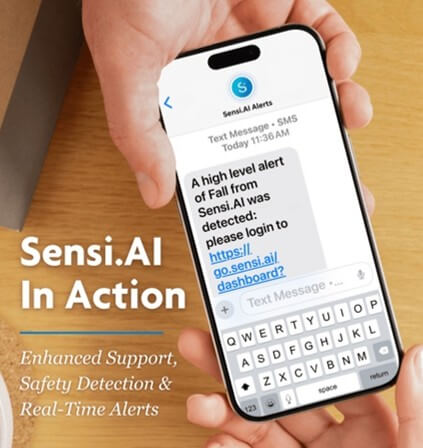
Image: Photograph showing a person holding a smartphone displaying a text alert from Sensi.AI about a high-level fall detection, with a link to a dashboard. Text on the left highlights Sensi.AI’s features of enhanced support, safety detection, and real-time alerts, alongside Assistance Home Care logo and establishment year.
>> SLIDE 5
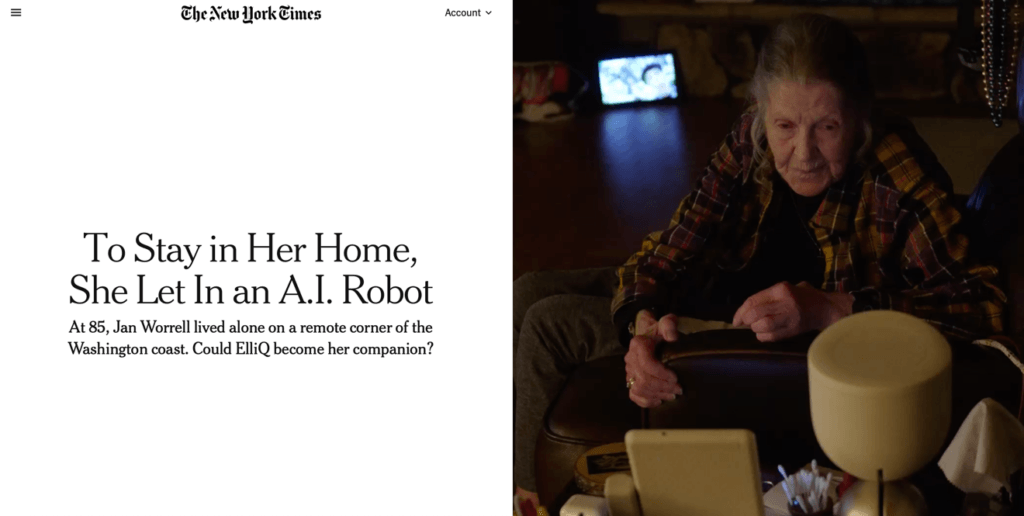
Image: Photograph showing an elderly woman sitting in a dimly lit room, interacting with a cylindrical A.I. robot on a table. The context highlights companionship technology for seniors, focusing on Jan Worrell, who lives alone and uses the ElliQ robot to stay connected and engaged.
>> SLIDE 6
What Does Independent Living Really Mean?
- Freedom of choice
- Autonomy
- Agency

Image: 2026 ANNUAL CONFERENCE ON INDEPENDENT LIVING Logo: Black text reads “PROTECT, PERSIST, PROSPER” in a bold, artistic style. National Council on Independent Living logo: a multicolored fingerprint.
>> SLIDE 7
The Burrito Test
- Focuses not on what a home looks like, but whether the person who lives there is able to do what they want, when they want
- There’s no difference between not being able to microwave a burrito at 3AM because someone in-person prevented you from it, or because an AI tool warned your family about it who then prevented you from it.

Image: A photo of a burrito wrapped in foil. You can see tortilla and a bit of filling, rice and guacamole.
>> SLIDE 8
Blurred Lines
- Technologies are blurring the lines between home and institution
- Our homes should be places where we can protect our privacy, and where we can choose what tech we want to use and when.
- Our commitment to independent living must include focusing on keeping disabled people at home and out of institutions, and keeping our homes free from unwanted surveillance.
>> SLIDE 9
Audience Q&A
Presenter Contact Information
Ariana Aboulafia
- ariana@cdt.org
- cdt.org/disabilityrights
Henry Claypool
2.3 Everything I Learned About Self-Care I Learned from My Cat
- Track: Building Resilient Organizations
- Target Audience: Appropriate for all audiences.
- Knowledge Level: Newcomer
- Location: Independence FGHI
Looking at self-care through the lens of lessons learned from our cat. Participants will learn about self-care and will leave inspired to look at their own self-care strategies. We need to promote a resilient workforce in order to keep the disability rights movement moving forward. No live cats will be invited or involved in the actual presentation.
Presenters
Alex Mikowski has served as the Executive Director for a small Center for Independent Living for the past three years. Alex is a person with a disability and a social worker by training. Outside of the office, Alex loves making cards and being near any body of water. Alex also volunteers at the local Elks lodge and for youth sports. She is also on the board of several local agencies. Alex lives in Cortland, NY with her husband Paul and her black cat named Yoda.
Dr. Paul Mikowski, Psy.D. is a person with a disability and a licensed clinical psychologist with nearly 20 years of experience with adult psychotherapy. His expertise is substance abuse recovery, suicide prevention, and mindfulness meditation. Paul is in recovery from substance use and other mental health disorders. Outside of the office, Paul loves board and video games, hiking, and campfires. He also volunteers with AFSP (American Foundation for Suicide Prevention) and his local Center for Independent Living! He lives with his wife Alex in Cortland, NY. Paul identifies as a person who is a member of the queer community.
Slide Deck
>> SLIDE 1
Title: Everything I learned about self-care I learned from my cat
Presented by: Paul Mikowski, Psy.D. & Alexandra Mikowski, MSW
July 21, 2026
>> SLIDE 2
Session description
Everything I learned about self-care I learned from my cat w/ Paul Mikowski, Psy.D. & Alexandra Mikowski, MSW
Looking at self-care through the lens of lessons learned from our cat. Participants learn about self-care and will leave inspired to look at their own self-care strategies
No live cats will be invited or involved in the actual presentation
>> SLIDE 3
Learning objectives
- Have fun!
- Each attendee can understand elements of self-care.
- Each attendee can identify self-care strategies that are demonstrated by our cat
- Each attendee can learn about the Stages of Change framework as it applies to this topic but also any other life change areas.
- We hope that each attendee will come away with at least one self-care strategy where they feel greater confidence to start or keep working.
>> SLIDE 4
Introduction of speakers
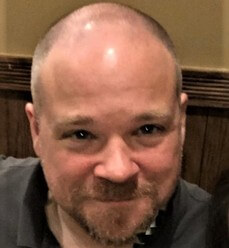
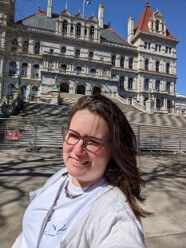
Image: Paul, a smiling white man with a beard and shaved head.
Image: Alex, a white female in her 40’s in a white ATI t-shirt in front of the NY State capital.
>> SLIDE 5
Dr. Paul Mikowski, Psy.D.
Is a person with a disability and licensed clinical psychologist with nearly 20 years of experience with adult psychotherapy. His expertise is substance abuse recovery, suicide prevention, and mindfulness meditation.
Paul is in recovery from substance use and other mental health disorders.
Outside of the office, Paul loves board and video games, hiking, and campfires. He also volunteers with AFSP (American Foundation for Suicide Prevention and his local ILC!
Paul identifies as a person who is a member of the queer community.
>> SLIDE 6
Alexandra (Alex) Mikowski, M.S.W
Executive Director for the past three years for a small independent living center. Alex is a person with a disability and a social worker by training.
Outside of the office, Alex loves making cards, and being near any body of water. Alex also volunteers at the local Elks lodge and for youth sports. She is also on the board of a several local agencies.
Alex lives in Cortland NY with her husband Paul and her black cat named Yoda.
>> SLIDE 7
Yoda Mikowski, C.A.T.
- He is a domestic short-haired feline with over ten years of experience
- Well-respected for his excellent ear length
- First selected for the role due to his youthful climbing proficiency
- One could say he has experienced transitioning from an institutional placement (ASPCA) to independent living…. With us!
- Hobbies include licking feathers, crinkling paper, and chasing the red laser pointer, which he claims he caught that one time we weren’t looking .
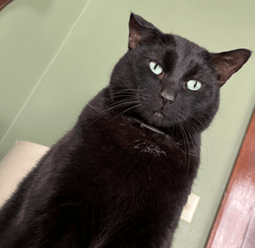
Image: Yoda a black short hair cat sitting with his ears up.
>> SLIDE 8
What is self care?
- Is it a trip to the beach?
- Is it a massage?
- While these may be awesome ways to disconnect, self-care doesn’t have to be expensive or elaborate.

Image: beach with a gentle wave coming in.
>> SLIDE 9
So why this approach to self-care?
You might learn better when there’s some humor and when you don’t have to compare with another human
Think about the animals you’ve known and loved- are there self-care strategies where they might inspire you to emulate them?
>> SLIDE 10
Don’t be afraid to be vulnerable, playful, and entertain others
- Many cats have a bit of clown in them and love to play
- Play is very important to mental health and can build community
- Tip from Yoda: It’s hard to play with a laser pointer by yourself
>> SLIDE 11
Experiment to learn how your world works
- Cats do things like pushing objects off the table or drinking the “wrong way” out of taps
- Some theorize that cats are natural scientists and run experiments to confirm even basic things, like the strength of gravity
- Not all things can be changed, but an attitude of hopelessness can make possible things unreachable
>> SLIDE 12
Put out boundaries
- Cats might squirm before or during being picked up
- Sometimes your body language will say it all
- Cats hiss if needed
- Other times, it’s useful to warn others that may encroach your boundaries
- Cats run away if they need to, or even hide
- You can’t easily control other people, but you can likely move to another location much more easily, when uncomfortable
>> SLIDE 13
Put out boundaries – cont.
- Cats bat or scratch with claws as a last resort
- Trying to control others with aggression usually backfires for humans
- Boundaries make clear what you don’t want, which can be gentle at first, but don’t be afraid to communicate more firmly
- Ultimately, they are about what you will do to protect yourself and your energy if someone else persists in their actions
>> SLIDE 14
Asking for what you want
- Cats use non-verbal’s such as purring, headbutting, staring at what they want, indicating where they want attention (Yoda has his expressive ears, flopping over, and rubbing his head with his paws to communicate)
- “Paint” success: describe your hopes, wishes, and fears assertively
- DEAR MAN method
- Describe what you see
- Express emotions
- Assert what you want to happen
- Reinforce the mutual benefit, if appropriate
- Mindfully approach the situation
- Appear confident
- Negotiate, if it’s not sacrificing too much of what you need
>> SLIDE 15
Rest
Tips from Yoda
- Find your favorite places to rest (he loves warm sun beams)
- Near heated surfaces or registers (or share human warmth!)
- Both short catnaps and deep sleep are awesome
You may not need 16 hours a day, like a cat, but you likely need 7-8 hours
>> SLIDE 16
Find time for exercise.
- Yoda loves chasing what we call “The Red Dot” (the laser pointer)
- Intense exertion can be fun, like Yoda’s “Zoomies” (randomly going as fast as you can up or down the stairs)
- Do as much or as little as works for your body
- Walks, dance, stretches, sports, and games all count
>> SLIDE 17
Fully enjoy your food
Yoda likes his kibble, Greenies™ treats, licking the yogurt spoon, sweet potatoes, or best of all: fish
- Yoda recommends you ask other people if they’ll share what they have
- Whether it’s meals, fruits/vegetables as snacks, or other treats, eat slowly/mindfully to savor what you can
>> SLIDE 18
If you fits, you sits
- Cats choose their favorite spaces and can be assertive getting to them
- They adapt to fill up different shaped resting places
- You deserve to take up space, too
- Mark your territory, if needed; hopefully with your words and objects only 🙂
>> SLIDE 19
Remember: someone aloof at first may open up if you build trust
- Like Yoda, many humans are wary at first of new people
- Trust is built slowly if you are consistent, do what you say you will, and show no aggression
>> SLIDE 20
Find your littermates or pride
Although cats are thought to like solitude, this stereotype is a broad generalization. Even Yoda liked a cat he grew up with, Caesar
Lions and kittens often play in groups
Community is one of the best ways to encourage good mental health
>> SLIDE 21
However, you don’t always have to go along with the pack
Cats know better than anyone that independence is important to not fall victim to groupthink.
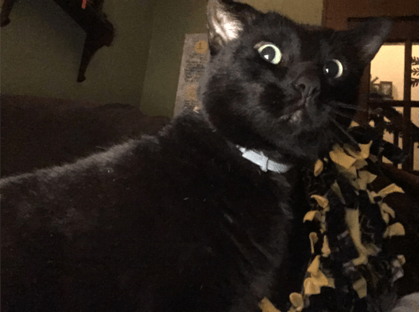
Image: Yoda, a black hair cat with a surprised / insistent face.
>> SLIDE 22
Bring gifts to loved ones
For cats, it can be toys, rodents, etc.…
For some people also, the favorite way for them to feel loved is getting gifts, but there are 5 Love Languages in total
- Acts of service
- Receiving gifts
- Quality time
- Words of affirmation
- Physical touch
>> SLIDE 23
Take your dignity and privacy seriously
- Many cats want a secluded litterbox
- Similarly, not everyone is entitled to know everything about you
- If something makes you feel undignified, it’s important to get away from that quickly
>> SLIDE 24
Keep your claws sharp
- Do the grooming that helps you feel good, whether it’s a manicure or a good stretch
- Sometimes maintenance is more important than constant performance
- Given 5 minutes to chop down a tree, the most efficient lumberjack spends some of that time sharpening/oiling the saw
>> SLIDE 25
Balance your time outside and indoors
- Many cats know there are nice things in both environments
- Adventure/variety vs comfort/security
- Assess if you are getting too little time outdoors; many people don’t get enough sunlight and fresh air
>> SLIDE 26
Be where the important documents are
- Cats know to set themselves on your computer, your papers, or even your hands to get the attention they need
- Nothing about us, without us
- Self-advocacy and participation in decisions are often the best way to get your needs met
>> SLIDE 27
Get your routine vaccinations
- Even though going may be scary, your doctor will be the best guide on preventing health conditions
>> SLIDE 28
Ok, so how do I learn from cats
It is exciting to think about a new way of doing things… but it can often feel like there is a huge gap between your preferred future and your current state.

Image: Horseback rider on desert butte. In the background is another mountain that is far away.
What tips would you like to try out or what obstacles do you anticipate?
>> SLIDE 29
Reflect on which of these lessons you can learn from cats
- Be playful
- Experiment with your world
- Set boundaries
- Ask for what you want
- Rest enough
- Savor food
- Take up space
- Build trust slowly
- Find your pride
- Avoid groupthink
- Love using the Languages
- Protect your dignity
- Keep claws sharp
- Time outdoors
- Self-advocacy
- Routine vet/medical visits
>> SLIDE 30
Stages of Change may be a good way to understand how to get there.
- Motivation to change naturally fluctuates, but can be built with help from others
- People at different stages of their change need different things
>> SLIDE 31
Stages of Change
Pre-contemplation
Characteristics: Not currently considering change: “Ignorance is bliss.”
Contemplation
Characteristics: Ambivalent about change: “Sitting on the fence.” Not considering change within the next month.
Preparation
Characteristics: Some experience with change and are trying to change: “Testing the waters.” Planning to act within 1 month.
Action
Characteristics: Practicing new behaviour for 3–6 months.
Maintenance
Characteristics: Continued commitment to sustaining new behaviour. Post 6 months to 5 years.
Relapse
Characteristics: Resumption of old behaviours: relapse or “Fall from grace.”
>> SLIDE 32
- So now that you know some ways to build momentum
- What self-care methods are you going to work on first?
We hope you feel greater confidence to start or keep working!
>> SLIDE 33
Contact info
Dr. Paul Mikowski
313 N. Tioga Street
Ithaca, 14850
Dr.Paul.Mikowski@gmail.com
Alex Mikowski, MSW
26 N. Main Street
Cortland NY 13045
Alex.Mikowski@aticortland.org
>> SLIDE 34
And now it’s time to rest, totally normally

Image: Yoda, a black cat lying sleeping on a bed, with his face covered by his outstretched paws
2.4 Project SHINE: Sexual and Reproductive Health Education Tools and Gaming for Youth with Disabilities
- Track: Advocacy in Action
- Target Audience: Appropriate for all audiences.
- Knowledge Level: Appropriate for all knowledge levels.
- Location: Lafayette / Farragut
Youth with disabilities deserve access to sexual and reproductive health (SRH) information just like anybody else. Project SHINE (Sexual Health Information Network for Equity and Education) was a project to create SRH education tools for youth with intellectual and developmental disabilities made by youth and others with disabilities. Join us to check out the resulting website and game that offer tools to learn about bodies, relationships, and sexuality.
Concurrent Workshops 3: Wednesday, July 22; 9:00-10:15 a.m.
3.1 Defending Civil Rights at the Intersection of Disability and Immigration Under Escalating Federal Enforcement
- Track: Advocacy in Action
- Target Audience: Appropriate for all audiences.
- Knowledge Level: Appropriate for all knowledge levels.
- Location: Independence A
This working session will draw from and expand on a March 11 webinar. What does federal enforcement mean for disabled immigrants’ civil rights, and what advocacy tools do we have? The Task Force’s 50+ organization coalition is a powerful proof of concept. This session will include small-group work on identifying local pressure points and drafting advocacy asks.
Presenters
Chris Ramos is the Latinx and Immigration Community Organizer at Access Living (since Jan. 2024), building spaces where Latinx immigrants with disabilities organize and advocate for systemic change. Formerly a volunteer with Cambiando Vidas, Chris draws on organizing training from Access Living, the Chicago Community Learning Partnership, and Alianza Americas. Raised in Chicago by Salvadoran and Guatemalan immigrants, Chris brings lived experience of the impacts of war trauma, undocumented status, gentrification, and disability. Chris advances equity through legislative advocacy, coalition-building, and grassroots campaigns.
Michelle Garcia (she / her) is Access Living’s Manager of Organizing and Community Development and has been with the organization since 2009, starting as the Latinx Community Organizer. She builds disability leadership in Latinx and immigrant communities and advances disability justice at the intersection of immigration and healthcare through education and partnerships. In 2016, she helped launch the National Coalition for Latinxs with Disabilities (CNLD) and serves as a co-founder and board member. After a 2019 summit, she supported creation of the Disability and Immigration Taskforce of Illinois (DITI). She also represents the 7th District on the Cook County Commission on Women’s Issues.
Claudia Castillo is a PhD candidate in Disability Studies at the University of Illinois Chicago, where her research focuses on structural barriers and community-led strategies at the intersection of disability and migration. She is a member of the Disability and Immigration Task Force of Illinois, a coalition of over 50 organizations, and previously served as Consul for Community, Cultural, and Political Affairs at the Mexican Consulate in Chicago, bringing extensive experience in bilateral policy, community diplomacy, and migration advocacy.
Slide Deck
>> SLIDE 1
Defending Civil Rights at the
Intersection of Disability
and Immigration Under
Escalating Federal Enforcement
Presented by:
The Disability and Immigration Taskforce of Illinois
Michelle Garcia, Access Living of Metropolitan Chicago
Claudia Castillo Ayala, PhD student in Disability Studies, UIC
Chris Ramos, Access Living of Metropolitan Chicago
July 22, 2026
>> SLIDE 2
Immigrants with Disabilities and the Future of Independent Living
- CILs exist to remove barriers to independent living, not to screen people for political comfort.
- Immigrants with disabilities are disabled people.
- If a disabled person cannot access information, services, housing, transportation, legal support, access to healthcare, family stability, or safety because of immigration enforcement, that is an Independent Living issue.
- The IL movement has always been strongest when it challenged systems, not when it waited for permission.
>> SLIDE 3
What immigration enforcement does to disabled people and families
- Escalating immigration enforcement
- Fear and isolation in immigrant communities
- Disabled people and families losing access to care, safety, and services
- CILs have a strong role to play in protecting rights
>> SLIDE 4
Immigration Enforcement is a Disability Justice Issue
- It disables people.
- It deepens existing disabilities.
- It separates people from care.
- It creates fear as an access barrier.
- It excludes disabled immigrants from services and safety.
>> SLIDE 5
Core values of the Independent Living Movement
Independent Living is about:
- Self-determination
- Community living
- Peer support
- Access
- Systems advocacy
- Freedom from segregation and institutional control
>> SLIDE 6
Who do we recognize as “our community”?
- Disabled people who speak English?
- Disabled people with documentation?
- Disabled people who know how to find us?
- Disabled people who trust service systems?
- Or all disabled people in our communities?
>> SLIDE 7
Serving immigrants with disabilities is not mission expansion.
It is mission correction.
When CILs serve immigrants with disabilities, we are not stepping outside the Independent Living mission. We are returning to it. We are asking whether our promise of community living applies only to the disabled people who are easiest to reach, or whether it applies to disabled people pushed to the margins by language, race, poverty, immigration status, fear, and state violence.
>> SLIDE 8
What We Heard Through our Webinar Series
Webinar 1: Our Core Argument
- Immigration enforcement as a disability justice issue
- Civil rights violations
- Movement silos
Webinar 2: Family Impacts
- Family separation
- Care disruption
- Fear
- Community harm
>> SLIDE 9
What Immigration Enforcement Disrupts
- Caregiving
- Medication and treatment
- Communication access
- Housing stability
- Transportation
- Income
- Legal support
- Education
- Family integrity
- Healthcare Access
- Trust in public systems
>> SLIDE 10
Fear as an Access Barrier
Fear can prevent people from:
- Seeking services
- Going to school
- Accessing health care
- Reporting abuse
- Requesting accommodations
- Appearing in court
- Calling emergency services
- Participating in community life
A CIL that wants to serve immigrant communities has to address not only physical access or program access, but also trust.
>> SLIDE 11
Family Separation as a Disability Justice Issue
Family separation can mean:
- Loss of caregivers
- Loss of income
- Loss of transportation
- Loss of communication support
- Loss of emotional regulation support
- Crisis for disabled children, parents, and elders
- Increased risk of institutionalization or neglect
>> SLIDE 12
Disabled Parents, Disabled Children, and Mixed-Status Families
Impacts appear across the family as:
- Disabled parents afraid to seek services
- Disabled children losing caregivers
- Disabled elders losing support
- U.S. citizen children affected by a parent’s detention or deportation
- Mixed-status families navigating impossible choices
>> SLIDE 13
Detention as an Access Crisis
Immigration detention raises disability concerns around:
- Physical access
- Medical neglect
- Mental health trauma
- Communication access
- Reasonable modifications
- Isolation
- Legal participation
- Continuity of care
- The loss of any of these rights has cost disabled lives
>> SLIDE 14
Civil Rights Do Not Disappear During Immigration Enforcement
We are not providing legal advice today. But we are grounding this conversation in disability civil rights principles that matter whenever disabled people interact with public systems, federally funded systems, enforcement systems, courts, detention, and services.
Immigration status is often used politically to justify exclusion. But disability does not disappear in enforcement contexts. Access needs do not disappear. Communication needs do not disappear. The need for reasonable modifications does not disappear.
>> SLIDE 15
Civil rights frame: ADA, Section 504, and disability discrimination
These laws create disability access obligations in many contexts, including public entities and federally funded programs.
Disability rights principles include:
- Equal access
- Reasonable modifications
- Effective communication
- Nondiscrimination
- Accessible programs and services
- Protection from disability-based exclusion
>> SLIDE 16
The Immigration System Is Often Built Against Disabled People
Disabled immigrants may face barriers related to:
- Medical inadmissibility frameworks
- Poverty and sponsorship requirements
- Language access
- Legal complexity
- Trauma
- Detention conditions
- Lack of accommodations
- Ableist assumptions about dependency and worth
>> SLIDE 17
War, Migration, and Disabled Bodies
Disability and migration are shaped by:
- War
- State violence
- Poverty
- Climate disaster
- Political instability
- Dangerous migration routes
- Detention and confinement
- Labor exploitation
- Lack of access to care
>> SLIDE 18
Why Our Movements Have Worked in Silos
Disability justice and immigrant justice have often been separated by:
- Funding structures
- Different policy languages
- Lack of shared relationships
- Race and language barriers
- Service eligibility confusion
- Fear of political risk
- Narrow definitions of “disability issues”
- Narrow definitions of “immigration issues”
>> SLIDE 19
The Cost of Working in Silos
When we work in silos:
- Disabled immigrants remain invisible
- Immigrant organizations lack disability access support
- CILs miss entire communities
- Families fall through gaps
- Advocacy campaigns are weaker
- Systems avoid accountability
>> SLIDE 20
Common Concerns from CILs
CILs may ask themselves:
- Are we allowed to serve undocumented people?
- What if we do not have immigration expertise?
- What if we do not have language capacity?
- What if funders question this work?
- What if this feels too political?
- What if we are already stretched thin?
>> SLIDE 21
CILs do not have to do everything.
But CILs can do something.
Starting points:
- Build partnerships
- Remove unnecessary barriers
- Improve language access
- Learn referral pathways
- Support disability accommodations
- Show up in coalition
- Make welcome visible
>> SLIDE 22
The question is not whether this work feels risky. The question is who carries the risk when we do not act.
It may feel risky for organizations to talk about immigration enforcement. But the risk already exists. Disabled immigrants carry it. Families carry it. Children carry it. People in detention carry it. People afraid to seek services carry it.
If CILs define safety as silence, then we have to ask: safety for whom?
>> SLIDE 23
Playing It Safe Has Never Built Justice
The disability rights movement was built by people who challenged:
- Institutions
- Segregation
- Inaccessible public systems
- Paternalism
- Exclusion
- Low expectations
- Rules designed without us
>> SLIDE 24
What CILs Can Bring to This Work
CILs bring:
- Disability access expertise
- Peer support
- Independent living skills
- Systems advocacy
- Benefits and services navigation
- Community transition knowledge
- Accommodation advocacy
- Local relationships
- Credibility as disability-led organizations
>> SLIDE 25
What Immigrant Justice Partners May Bring
- Community trust
- Language capacity
- Legal referral knowledge
- Know-your-rights infrastructure
- Cultural knowledge
- Rapid response networks
- Family preparedness tools
- Organizing experience
>> SLIDE 26
Models That Are Already Possible
- Partnership and referral model
- Disability access support model
- Family stability model
- Know-your-rights accessibility model
- Emergency planning model
- Coalition advocacy model
There is no single model every CIL has to adopt. Rural CILs, urban CILs, border-state CILs, and CILs in states with different political climates may begin differently. But there are clear entry points.
>> SLIDE 27
Examples from the Field
- Cross-training between disability and immigrant rights organizations
- Accessible know-your-rights events
- Emergency plans for disabled family members
- Referrals between CILs and legal service providers
- Multilingual outreach
- Disability access consultation for immigrant-serving groups
- Coalition advocacy on detention, family separation, language access, and public benefits
>> SLIDE 28
What CILs Can Do in the Next 30 Days
- Identify three immigrant-serving organizations in your area
- Review intake forms for unnecessary immigration-related questions
- Add welcoming language to your website and materials
- Create a basic immigration legal referral list
- Ask partners what disability access barriers they see
- Identify top community languages
- Train staff on fear as an access barrier
>> SLIDE 29
What CILs Can Build in the Next Year
- Build formal partnerships
- Host cross-trainings
- Translate core materials
- Develop emergency planning tools
- Include immigrants with disabilities in strategic plans
- Apply for funding focused on underserved communities
- Join immigrant justice coalitions
- Recruit immigrant disabled leaders into advisory spaces
>> SLIDE 30
Reflection Questions for the Audience
Ask yourself:
- Who is not finding our CIL?
- Who does not trust us yet?
- What communities have we treated as outside our mission?
- What barriers are we creating without realizing it?
- What partnerships do we need?
- What risk are we avoiding, and who pays the price?
>> SLIDE 31
Immigrants with disabilities are not outside our mission. They are a test of whether we mean what we say.
The Independent Living movement has always insisted that disabled people belong in the community. But community includes people who are undocumented. It includes mixed-status families. It includes people afraid to open the door, afraid to go to court, afraid to take their child to school, afraid to seek medical care, afraid to ask for help.
If our movement is only visible to disabled people who already trust systems, speak English, have stable documentation, and know how to find us, then we are not reaching the whole community.
Immigrants with disabilities are not outside our mission. They are a test of whether we mean what we say.
The next chapter of Independent Living must be multilingual, multiracial, cross-movement, and brave enough to confront the systems that disable and disappear our people.
They are already our people. The question is whether our movement will meet the moment and act like it.
>> SLIDE 32
Contact Information
Michelle Garcia, mgarcia@accessliving.org
Claudia Castillo Ayala, ccast48@uic.edu
Chris Ramos, cramos@accessliving.org
3.2 Centers for Independent Living and Veteran-Directed Care: A Match Made in IL Heaven
- Track: Building Resilient Organizations
- Target Audience: Executive Directors and Board Members
- Knowledge Level: Experienced
- Location: Independence BCDE
Centers for Independent Living and the Veterans Administration (VA) Veteran-Directed Care program belong together.
It is the goal of all Centers for Independent Living to find financial diversity equating to stability, while balancing the mission-driven perfect alignment of the Independent Living philosophy. It has also been the goal of the nine Centers for Independent Living of Colorado to create a symbiotic partnership that would link the Centers together in the next 50+ years to create a stronger CIL interstate network.
Presenters
Rochelle Mitchell, PMP (Project Management Professional), is a 22-year veteran of the nonprofit sector, having held executive leadership positions with the Douglas County Community Foundation, High Plains Library District, Weld Community Foundation, Right to Read, and Larimer Humane Society. Rochelle is the current Chief Executive Officer of Connections for Independent Living, the CIL that covers all of northeastern Colorado. She is a person with a neuro disability and a competitive rower. She attended the University of Missouri-Columbia and Colorado State University, and holds Master’s certificates in project management and nonprofit administration.
3.3 Strengthening Bipartisan Support for Disability Rights: Working Across the Aisle
- Track: Advocacy in Action
- Target Audience: Appropriate for all audiences.
- Knowledge Level: Appropriate for all knowledge levels.
- Location: Independence FGHI
Disability rights have never belonged to one political party. From the Rehabilitation Act to the ADA, our movement has been strongest when advocates worked across political lines to advance freedom, opportunity, and community living for disabled people. This session will explore practical lobbying strategies, relationship-building with policymakers, and effective messaging that resonates across the political spectrum. Participants will also learn about the American Disability and Aging Alliance (ADAA) and opportunities to engage in national initiatives advancing disability and aging policy. The ADAA was created by leaders from ten disability-led organizations and now works with bipartisan legislative advocates in Washington, D.C. to advance disability and aging policy priorities.
Slide Deck
>> SLIDE 1
Strengthening Bipartisan Support for Disability Rights
Working Across the Aisle
Presented by: ADAA Members & Scott Binkley, McGuireWoods Consulting
July 22, 2026
>> SLIDE 2
Disability Rights Should Not Be Partisan
- Disability affects every family, community, and political party.
- Our greatest victories came through bipartisan leadership.
- Civil rights should never depend on who controls Congress.
- Today’s advocacy requires relationships, not political warfare.
Protect disability rights by bringing people together.
>> SLIDE 3
A Bipartisan Legacy
Major milestones made possible through bipartisan leadership:
- Rehabilitation Act of 1973
- Section 504
- Americans with Disabilities Act (ADA)
- Olmstead Decision
- Workforce Innovation and Opportunity Act (WIOA)
- Americans Cares Act
- Individuals with Disabilities Education Act (IDEA)
Republicans, Democrats, Independents, businesses, families, and disabled advocates all helped shape disability rights.
>> SLIDE 4
Facing a Harder Political Environment
- Disability policy has faced growing political polarization in recent years.
- It has become harder for organizations to maintain relationships across both parties.
- Advocacy has become transactional instead of relational.
If we stop talking to one side, we stop influencing it.
>> SLIDE 5
Friendship Is Not Endorsement
- Meet with policymakers from every party.
- Respect people without agreeing on every issue.
- Educate instead of argue.
- Find common ground while standing firm on disability rights.
The best advocates build bridges, not burn them.
>> SLIDE 6
Why This Matters Now
Disability rights are under pressure.
Current issues include:
- Medicaid
- HCBS
- Independent Living
- Employment
- Housing
- Transportation
- Education
- Civil Rights Enforcement
We need champtions on both sides of the aisle.
>> SLIDE 7
Disability Rights Are Like a House
The foundation includes:
- ADA
- Section 504
- Medicaid
- HCBS
- IDEA
- Olmstead
- Independent Living Programs
- National Institute on Disability, Independent Living, and Rehabilitation Research (NIDLRR)
When one piece weakens, the entire structure becomes more vulnerable.
>> SLIDE 8
Advocacy vs. Lobbying
Advocacy
- Education
- Storytelling
- Awareness
- Lived experience
Lobbying
- Meeting policymakers
- Requesting policy action
- Tracking legislation
- Building relationships
Both are essential.
>> SLIDE 9
Relationships Win
- Show up consistently.
- Become a trusted resource.
- Listen before you speak.
- Learn legislative priorities.
- Stay engaged, even when you disagree.
>> SLIDE 10
Communicating Across the Aisle
Frame disability issues around shared values.
- Independence
- Family
- Employment
- Fiscal responsibility
- Civil rights
- Community participation
Effective advocacy changes the conversation – not your values.
>> SLIDE 11
Stories Change Policy
Facts inform.
Stories persuade.
Tell stories that include:
- The challenge
- Human impact
- Policy barrier
- Solution
- Outcome
- Fiscal impact
>> SLIDE 12
Avoid These Common Mistakes
- Letting disability rights become a partisan wedge issue.
- Burning bridges
- Showing up only during a crisis
- Failing to follow up
- Avoiding one political party
>> SLIDE 13
The American Disability & Aging Alliance (ADAA)
A disability-led coalition advancing national advocacy through collaboration.
Our priorities:
- Protect rights, Medicaid & HCBS
- Advance Independent Living
- Protect IL & disability research funding
- Build bipartisan relationships
- Ensure disability-led voices are at every decision-making table
>> SLIDE 14
Together, we are stronger than any one organization.
What ADAA Has Accomplished In less than one year:
- Relationships with approximately 26 Members of Congress
- Meetings with Congress, CMS, and HHS
- Three national advocacy fly-ins
- Advanced federal appropriations priorities
- Coordinated national messaging
- Elevated disability and aging priorities nationally
Collective advocacy gets results.
>> SLIDE 15
Partnering with McGuireWoods Consulting
A bipartisan government relations firm helping ADAA:
- Build congressional relationships
- Monitor legislation
- Develop advocacy strategy
- Connect grassroots advocates with policymakers
- Provide federal policy intelligence
Also a law firm with a large team of experts
Grassroots advocates tell the story. McGuireWoods helps those stories reach decision-makers.
Meet Scott Binkley
>> SLIDE 16
Join the Effort
Whether you’re a CIL, disability organization, aging organization, or community partner, there’s a place for you.
You Can:
- Support ADAA by joining and contributing funds
- Be at the table/Monthly updates
- Receive monthly federal policy updates
- Participate in congressional and administration meetings
- Build bipartisan relationships
- Share your expertise
- Help shape national disability policy
Together, we can restore bipartisan disability advocacy.
>> SLIDE 17
Questions?
>> SLIDE 18
Contact Information
ADAA (American Disability and Aging Alliance)
3.4 Beyond the Checklist: Student-Centered Advocacy in Action
- Track: Empowered to Lead
- Target Audience: Appropriate for all audiences.
- Knowledge Level: Appropriate for all knowledge levels.
- Location: Lafayette / Farragut
Learn how our participant-centered approach meets Vocational Rehabilitation standards while addressing the whole person. We identify strengths, needs, and interests first, then align supports with Pre-ETS categories, balancing compliance with meaningful, individualized services that build engagement and improve outcomes.
Presenters
Danielle Bentley is a dedicated educator, proud disabled woman, and mom of two. With over eight years of teaching experience, she brings a deep passion for education and empowering students. Danielle holds a Child Development credential specializing in ages 3–5, a Bachelor’s in Elementary Education, and a Master’s in Elementary Education. She is currently completing her second Master’s Degree in Educational Technology and Instructional Design, which she uses to design accessible, technology-rich learning experiences that prepare students with disabilities for job exploration and workplace readiness. Dedicated to preparing students for life beyond the classroom, Danielle loves integrating real-world skills into her teaching, helping young adults discover their futures, embrace possibilities, and realize their full potential.
Slide Deck
>> SLIDE 1
Beyond the Checklist: Student-Centered Advocacy in Action
Presented by: Danielle Bentley, Simone Cravatta, and Teagan Lobdell
July 22, 2026
>> SLIDE 2
Danielle Bentley
Futures Coordinator, Disability EmpowHer Network
- Former educator and transition specialist
- Coordinates Empowered Futures, a Pre-Employment Transition Services (Pre-ETS) program
- Supports youth and young adults with disabilities in career exploration, self-advocacy, workplace readiness, post-secondary planning, and work-based learning experiences
- Represents Disability EmpowHer Network, a nonprofit organization run by and for girls and women with disabilities
>> SLIDE 3
Co-Presenters
Simone Cravatta
- Empowered Futures Pre-ETS participant
- Disability advocate and self-advocate
- Student leader navigating the transition to college and employment
Teagan Lobdell
- Empowered Futures Pre-ETS participant
- Self-advocate and emerging leader
- Actively building skills in employment, independence, and community engagement
>> SLIDE 4
Workshop Overview
This workshop explores how a student-centered, holistic approach to Pre-ETS and transition services can be delivered within Vocational Rehabilitation (VR) standards while still prioritizing youth voice, strengths, and goals. Participants will learn practical strategies to move beyond compliance-based services and toward meaningful, individualized support that increases engagement and improves outcomes for youth with disabilities.
Through real examples, youth co-presenters, and interactive activities, attendees will examine how to align VR deliverables with what students truly need to succeed in school, work, and independent living.
>> SLIDE 5
Disability EmpowHer Network
Our Mission
Empowering girls and women with disabilities through mentoring, leadership development, self-advocacy, and transformational learning experiences.
Who We Are
- A nonprofit organization run by and for women with disabilities
- Serving youth and adults across New York State
- Committed to increasing independence, confidence, community engagement, and employment outcomes
Our Vision
A world where girls and women with disabilities are empowered to lead, advocate, and thrive in their communities.
>> SLIDE 6
Simone’s Story
>> SLIDE 7
Teagan’s Story
>> SLIDE 8
ACCES-VR Standards for Self-Advocacy Skills:
- Understanding one’s disability
- Disclosure of disability
- Decision-making and problem solving
- Safe and responsible use of social media and the internet
- Goal setting
- Self-awareness and independent living skills
- Disability accommodations
- How to request and utilize accommodations
>> SLIDE 9
ACCES-VR Standards for Self-Advocacy Skills:
- Understanding work cultures and how to adapt to varying cultures
- Self-determination skills
- How to request and accept help
- Identifying intrinsic strengths and capabilities
- How to take a leadership role in support plans
- Assertiveness skills
- Understanding of your civil rights
- Understanding the value of listening to feedback from others
>> SLIDE 10
ACCES-VR Standards for Self-Advocacy Skills:
- Developing positive self-talk skills and understanding the value of and when to utilize those skills
- Connecting with peers and the value of peer-mentoring
- Learning about different services in the community and how to apply for services
- Understanding your rights and responsibilities
>> SLIDE 11
Contact Information
Danielle Bentley
Futures@DisabilityEmpowHerNetwork.org
585-200-5599
WWW.DisabilityEmpowHerNetwork.org
Concurrent Workshops 4: Wednesday, July 22; 10:30-11:45 a.m.
4.1 Addressing the Direct Care Crisis: Creating an Advocacy Campaign around Direct Care
- Track: Advocacy in Action
- Target Audience: Advocates and Project Directors
- Knowledge Level: Appropriate for all knowledge levels.
- Location: Independence A
The disability community has faced significant challenges in finding, keeping, and training direct care workers who can assist people with disabilities to live independently since the inception of community-based services. This workshop gives an overview of the crisis and the advocacy activities one CIL, The Ability Center, has taken to try to address it. As we discuss the actions taken by The Ability Center, we will look to the participants of this workshop to share their own knowledge and advocacy actions on direct care. This interactive workshop will allow CILs to learn about each other’s advocacy on this important issue and share stories on what has worked and what hasn’t worked in addressing this crisis.
Presenters
Katie Hunt Thomas is the Disability Rights Attorney for the Ability Center of Greater Toledo, a Center for Independent Living in northwest Ohio with the mission to assist people with disabilities to live, work, and socialize within a fully accessible community. She received her B.A., magna cum laude, from Xavier University and J.D., cum laude, from the University of Toledo College of Law. Ms. Thomas is also a part-time professor of disability law at the University of Toledo College of Law.
Jules Patalita (he / him) is a Disability Rights Advocate for The Ability Center of Greater Toledo, a Center for Independent Living in northwest Ohio. He holds a PhD in Media and Communications, previously serving as a professor of digital media and interactive technology. Now focusing on public access and healthcare, Jules creates educational materials that simplify complex topics. He believes that informing the community means starting at their level of knowledge and building from there.
Materials
>> SLIDE 1
Addressing the Direct Care Crisis: Creating an Advocacy Campaign around Direct Care
Presented by:
Katie Hunt Thomas, Director of Advocacy and Disability Rights Attorney, The Ability Center
Jules Patalita, Disability Rights Advocate, The Ability Center
July 2026
Footer Image: The Ability Center logo, A gold box with a stylized white A.
>> SLIDE 2
Outline of this session
- Who are we?
- What is the direct care crisis and how has that manifested in Ohio?
- What actions have we taken to combat the direct care crisis?
- Research and education
- Budget advocacy
- Wage Study
- HB 530: Establish a long- term Care Workforce Study Committee
- Discussion – what is going on in your state?
>> SLIDE 3
Who are we?
The Ability Center is a Center for Independent Living Serving thirteen counties in NW Ohio. The major city within our service area is Toledo, Ohio.
Together, we work to make our community the most disability-friendly in the nation by increasing independence for people with disabilities, discovering true passions, and changing the community’s perception of disability.
>> SLIDE 4
What is the direct care crisis and how has that manifested in Ohio?
- The Issue: There are not enough direct care workers to serve everyone in the community who needs one. Without enough direct care workers, people may be forced into institutional settings.
- This is an issue across the country.
>> SLIDE 5
Detailed overview of the issue
- People with disabilities and aging Ohioans need direct care workers to live independently in their homes.
- Many people use direct care workers to complete their activities of daily living – getting out of bed, bathing, toileting, eating, re-adjusting their position, etc.
- Some people use direct care workers for incidental activities of daily living – for example, transportation and socialization
- Either way, direct care workers are key to independent living
>> SLIDE 6
A note on language
- In Ohio, different Medicaid HCBS Waivers call direct care workers by different terminology
- Home Health Aide (HHA)
- Direct Service Provider (DSP)
- Personal Care Aid
- Home Care Aide
- Advocating for one of these roles often means only one system, so we settled on Direct Care Worker to encompass all systems
>> SLIDE 7
Ohio, and other states, fail to create a robust system of direct care
- Direct care workers are a reimbursable service through Medicaid, but there are not enough workers to fill the need
- In Ohio, nearly 70% of direct care workers leave their position within a year – DODD survey, 2022
- In our survey, 54.43% of Respondents stated that there is a high turn- over of direct care providers and that their staff changed often
- 39.11% stated that they are sometimes left for hours at a time without an in-home provider
>> SLIDE 8
The problem is national
- Nationwide, the direct care workforce consists of approximately 5.4 million workers including home care workers, residential care aids, and nursing assistants
- Nationally, turn- over of direct care workers is 60-80% annually
- Over the next decade, the sector needs to create 772,000 new direct care jobs to meet the need
>> SLIDE 9
Personal stories
- Around 2020, especially, we began to hear from people with disabilities who couldn’t find direct care workers. Our I & R line was also receiving increased calls.
- One person who relied on direct care workers to get her out of bed described being left without care for weeks. Her issue was how long it took for new direct care workers to be approved by the department of Medicaid. In order to sign up to be her worker, they needed to provide care without pay for nearly six weeks.
- One person’s family member required complete care, and she often had new direct care workers leave before the end of their first shift because they didn’t want to provide the level of care required.
>> SLIDE 10
Personal stories, continued
- One person’s aging parents needed direct care workers to remain independent in their home. Even though they were on Medicaid, the caller had to hire college students using private pay in order to get people to help her.
- One young person who was blind and deaf was hit by a car crossing the street because he could not find someone to act as his direct care worker.
- We received multiple calls from people whose direct care worker just never showed up for their shift, leaving them in the lurch, and who could not find another one.
>> SLIDE 11
A lack of direct care workers is a health and safety issue and a threat to people’s independence
- Across the board, many people would rather live at home with no support than go into an institutional setting like a nursing home or ICF
- If someone relies on direct care for all activities of daily living, this is a safety issue
- A lack of direct care workers makes it impossible for people to work and engage in normal day- to- day activities
- Places people at risk of institutionalization
>> SLIDE 12
Why is there a shortage of direct care workers?
- Low wages: Medicaid provides reimbursement for direct care as a service but does not control how much workers receive.
- No benefits: Many direct care providers do not receive health insurance, sick leave, travel reimbursement, or retirement benefits.
- No career path: Most direct care workers have no chance of promotion. If they continue to work their jobs, there is no opportunity for them to move up.
- Difficult work: The qualifications and level of pay for direct care workers equal that of a fast food or retail job. Many people who enter the field aren’t called to be health care workers and can get jobs with steadier hours, comparable pay, benefits, and easier tasks.
>> SLIDE 13
Our campaign
- In 2020, we found ourselves to be in a particular crisis. Community members kept contacting us out of desperation because a direct care worker hadn’t shown up for the day or because they could not find anyone.
- One of our long-term policy goals is to ensure that health care services are provided in the community, rather than in institutional settings, so we decided to take action.
>> SLIDE 14
Forming a coalition
- The Ability Center is part of a statewide coalition called the Ohio Olmstead Taskforce
- Once we had identified this as an issue, we formed a committee on that taskforce called the Direct Care Taskforce
- While we further researched the issue, we began to take action as part of that taskforce to begin drawing attention to the issue
- We drafted a sign on letter for the state Department of Medicaid, organized statewide editorials/ letters to the editors, and organized regional public forums to discuss the issue
>> SLIDE 15
Forming a coalition, continued
- For each of these, we sent out press releases to get the issue into the news
- We also drafted common talking points that each member of the taskforce could use to share with their own regional legislators to begin talking about this issue
>> SLIDE 16
Researching solutions
- Our advocacy team drafted an issue brief using research from around the country to name the problem and identify solutions
- While we knew the problem was multi-faceted, we kept hearing about low wages, which at the time, averaged $12/ hour
- We found a legislative model in the State of Maine, which raised wages for direct care workers
>> SLIDE 17
Researching solutions, continued
- Maine had established a legislative commission to study long term care workforce issues to form solutions to the crisis
- Direct care workers are legally entitled to a minimum wage floor equal to 125% of the state’s minimum wage
- Also established a long- term care workforce oversight advisory committee to provide advice and oversight to HHS committee
>> SLIDE 18
2023 Budget advocacy
- In 2023, we formed a specific budget advocacy work group around setting a minimum wage for direct care workers and also advocated for a long-term care study commission
- That workgroup crossed the aisle to encompass any groups affected by the direct care shortage: aging, disability-specific groups, CILs, our P & A
- Each of these groups met on a monthly basis to coordinate advocacy, and each activated their own advocacy network
- We also held a day at the statehouse to meet with legislators and drop off our issue briefs and talking points
- All groups came together to give testimony and recruit testimony
>> SLIDE 19
2023 Budget advocacy, continued
- We worked directly with interested legislators to get a base wage for direct care workers and long- term care workforce study commission into the budget bill
- The final budget bill increased funding for direct care workers and established a wage floor for workers of $15 for the first year and $16/ hour for the second year – the long- term care study commission was taken out
- The budget bill also required the state to track this issue, to collect data on direct care wages
- But when it got to our Governor’s desk, he vetoed the wage floor – though he left the increased funding for direct care
>> SLIDE 20
What came next?
- We began preparing for the next budget cycle. We wanted to be able to argue that the increased funding without a set base wage did not do enough to solve the crisis
- We began a regional study of direct care givers and care agencies to gauge the impact of the reimbursement increase
- We also introduced the long- term care study commission as a stand-alone bill
>> SLIDE 21
The Ability Center Wage Study
- 95% of home care agencies believe there is a worker shortage
- Almost 50% of caregivers receive no benefits from their agency. No caregivers reported that their agency began to offer benefits as a result of the reimbursement increase
- More than 90% of home care agencies believe that higher wages for workers would result in higher quality care for individuals
- The average turnover for our participants was only 3.16 years as a caregiver, which is especially low for a skills-based profession
- Over 15% of participants had not received a wage increase in the last year, meaning the reimbursement increase did not affect their wage
>> SLIDE 22
The Ability Center Wage Study Continued
- 50% of caregiver participants learned about the reimbursement increase during the focus group, showing that Medicaid and their agency were not communicating the increase well. It also means the increase didn’t have a noticeable impact for those caregivers
- 1 in 6 caregivers noted that caregivers are not given enough respect for the work they provide
- 73% of caregivers had only received a single wage increase during their tenure as a caregiver. This includes those who would have received an increase due to the reimbursement increase
- The findings of our regional survey were that the average wage among participants in 2023 was $17.38 an hour, with 2024 average wages being $18.96 an hour
>> SLIDE 23
Working Towards a Long- Term Care Study Commission
- Set up a monthly coalition on the Long Term Care Study Commission
- Organized a sign on letter
- Organized testimony
- Passed out of House Committee unanimously
>> SLIDE 24
HB530, Long-Term Care Study Commission
- Since 2024, we have been working with two legislative sponsors to introduce a Long- Term Care workforce Study Commission
- The bill would establish a legislative commission to study the long- term care workforce in Ohio
- Sets out goals for the commission
- Sets out members of the commission
- Sets out a term for creating a report
>> SLIDE 25
Other actions that have had an impact
- Medicaid reimbursement for family caregivers
- Increased self-direction in Ohio
Results
- We are still working on this issue, but the discussion and increased reimbursement have had an impact
- We have heard especially from organizations that manage waivers that it is easier to find direct care workers than it was
- Coalitions have been easier to organize because other groups have already taken action on this issue
>> SLIDE 26
Lessons
- Persistence is Key: the more you talk about an issue, the less you have to convince others that it is an issue
- A disability coalition is very powerful:
- Often, we find ourselves in silos but when we come together, it is hard to ignore us
- Every group that was involved in the 2023 budget advocacy takes credit for coordinating the advocacy and the resulting increase in funding; the reality is that while we worked together on this, each group took leadership of their own network and that was powerful advocacy
>> SLIDE 27
Lessons, continued
- Change is often incremental. Each piece of this project was a huge project of its own, but each moved the needle a tiny bit and that is how change is taking place
- We are on the verge of having to change strategies because the political climate has changed, and likely will change, in Ohio, but we keep moving forward and can make more of a difference at a state level than you would think
>> SLIDE 28
Discussion questions
What has your organization done?
What strategies have been successful?
What strategies have not been successful
>> SLIDE 29
Contact Information
Katie Hunt Thomas, Director of Advocacy and Disability Rights Attorney, kthomas@abilitycenter.org
Jules Patalita, Disability Rights Advocate, jpatalita@abilitycenter.org
>> SLIDE 30
Image: 2026 ANNUAL CONFERENCE ON INDEPENDENT LIVING Logo: Black text reads “PROTECT, PERSIST, PROSPER” in a bold, artistic style. National Council on Independent Living logo: a multicolored fingerprint.
4.2 Shared Stewardship: A Lab for Emerging and Legacy Leaders
- Track: Empowered to Lead
- Target Audience: Appropriate for all audiences.
- Knowledge Level: Appropriate for all knowledge levels.
- Location: Independence BCDE
This interactive lab bridges the gap between frontline grit and executive leadership. Moving beyond traditional barriers to advancement, we explore how Community Wisdom — the unwritten history and strategic memory of our CILs — serves as our most valuable professional asset. Through a series of parallel activities, legacy leaders will identify high-level spaces they are ready to vacate, while emerging leaders identify the “Big Things” they are ready to own. Attendees will leave with a concrete “Growth Partnership” plan that protects organizational stability, persists in honoring lived experience, and advances prosperity by strengthening our leadership pipeline from the ground up. Join us to build the bridge for the next generation.
Presenters
Brittany Boyd-Chisholm is a dedicated leader with 20 years of experience advocating for home and community-based services. Her career is a testament to the “Full Circle” leadership model, having begun her journey in 2005 as a Certified Nursing Assistant (CNA) providing Personal Assistant Services (PAS). Motivated by a belief that care should be personalized and consumer-controlled, Brittany transitioned from the front lines into administrative leadership roles, including Receptionist, Office Manager, Quality Assurance Monitor, Scheduler, and Managing Director. Brittany often says she “grew up” in the Independent Living movement. This foundation remains the core of her values and her vision for Thrive CIL. After spending eight years in the private homecare sector as an Administrator — she spearheaded significant operational growth and served on the Board of Directors for the Pennsylvania Homecare Association (PHA) — Brittany made the intentional decision to return to the Center for Independent Living of Central PA (now rebranded as Thrive CIL). This move was driven by a desire to step beyond a “billing mindset” and refocus on the core services that empower people to not only live independently but to truly thrive in the community.
Slide Deck
>> SLIDE 1
Shared Stewardship
A Lab for Emerging and Legacy Leaders
Brittany Boyd-Chisholm, CEO, Thrive CIL
NCIL 2026 Annual Conference

Image: Illustration of an arched bridge connecting two cliffs beneath a golden sun. On each side, pairs of people, including wheelchair users, stand facing the bridge, representing two communities coming together.
>> SLIDE 2
Protecting Disability-Led Leadership

Image: Illustration of a large teal shield protecting three people, with a wheelchair user front and center. A gold circle with a checkmark floats above them, symbolizing safeguarded disability-led leadership.
- How do we ensure the Independent Living movement remains led by those with the deepest lived experience?
- Lived experience is not a baseline credential — it is an executive competency.
- Traditional professional paths create unnecessary barriers to executive advancement.
>> SLIDE 3
From the Front Lines to the Executive Office
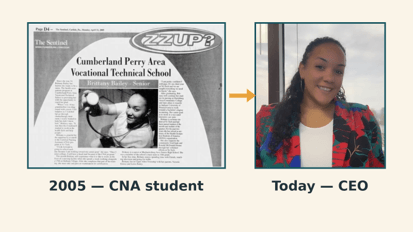
Image: Two framed photographs side by side showing Brittany’s career journey. Left, labeled 2005 – CNA student: a newspaper clipping from The Sentinel featuring high school senior Brittany Bailey holding a stethoscope, in an article about the Cumberland Perry Area Vocational Technical School nursing assistant program. A gold arrow points to the right photo, labeled Today – CEO: Brittany Boyd-Chisholm smiling in a colorful floral blazer, now CEO of Thrive CIL.
- 20-year journey: CNA → CEO (2005-present)
- Frontline experience = direct insight into community barriers and consumer control
- The reality: one-week handoff and learning on the fly
- We must build intentional transitions, not survival by trial-by-fire
>> SLIDE 4
Defining Community Wisdom

Image: Illustration of an open book with lines of text on the left page and a golden tree growing from the right page, symbolizing community wisdom and unwritten history taking root.
- Unwritten History: Narrative of systemic advocacy battles and local policy wins
- Strategic Memory: The philosophical ‘why’ behind our operational choices
- When legacy leaders leave without transition plans, their wisdom walks out the door
- Our unwritten history keeps us rooted in consumer control
>> SLIDE 5
The Learning Roadmap

Image: Illustration of a winding road climbing from lower left to upper right with four colored milestone markers along the way and a flag at the summit, representing the four-part learning roadmap: Protect, Persist, Advance, Strengthen.
PROTECT — Organizational Stability — Transfer unwritten history before transition occurs
PERSIST — Lived Experience — Use a shared framework to validate frontline tenure
ADVANCE — Professional Growth — Build concrete ‘Step Up’ pathways into high-level spaces
STRENGTHEN — Leadership Pipelines — Legacy leaders create ‘Intentional Voids’ for rising leaders
>> SLIDE 6
Part 1: The Stewardship Audit

Image: Illustration of an organizational chart of connected people, with a large orange magnifying glass examining one branch, representing an audit of where power is held in an organization.
- Identify where power is held in your organization
- Emerging Leaders: Map your target growth spaces
- Map the unique frontline assets you bring
- Legacy Leaders: Identify your ‘intentional voids’
- Where can you safely step back to create mentorship room?
>> SLIDE 7
Part 2: Reciprocal Wisdom Exchange

Image: Illustration of two people facing each other, one a wheelchair user, with curved arrows flowing between them in both directions around a plus sign, representing a two-way exchange of wisdom between emerging and legacy leaders.
- Pair up across state lines and organization types
- Rising Voice: Share modern community barriers and grassroots pulse
- Veteran Voice: Share historical movement context and institutional strategy
- Trade value for value — both have something essential to teach
- Cross-pollinating frontline grit with systemic memory
>> SLIDE 8
Part 3: Peer-Consulting Lab
Image: Illustration of five people of varied colors gathered around a large oval table with documents on it, including a wheelchair user, representing a collaborative peer-consulting session.
Translate grassroots service into high-level organizational value
Emerging Leaders: Practice your Step-Up Pitch
Legacy Leaders: Act as executive consultants
Map how frontline expertise becomes systemic competency
Refine your ask — make it undeniable to a board or CEO
>> SLIDE 9
The Pledge of Stewardship

Image: Illustration of a lit torch held high at the center with five raised hands of different colors reaching upward toward it, representing a shared pledge to pass leadership forward.
We pledge to protect the unwritten history of our movement.
We pledge to build intentional pipelines for disability-led leadership.
We pledge to share stewardship by design, not by accident.
We pledge to bring one concrete transition action back to our home community.
We pledge to ensure that no rising leader has to learn executive functions on the fly.
We are the keepers of Community Wisdom. And we choose to pass it forward.
>> SLIDE 10
Questions & Contact

Image: Illustration of an arched bridge over teal ground with a speech bubble and a golden sun above. A person stands at one end of the bridge and a wheelchair user waits at the other, inviting conversation and connection.
Brittany Boyd-Chisholm
CEO, Thrive CIL
bchisholm@thrivecil.org
www.thrivecil.org
Let’s build the bridge together
4.3 Architects of Resilience: Designing a Cross-Disability Emergency Infrastructure
- Track: Building Resilient Organizations
- Target Audience: Appropriate for all audiences.
- Knowledge Level: Appropriate for all knowledge levels.
- Location: Lafayette / Farragut
The presentation focuses a proactive, localized approach to emergency management and systemic advocacy. It addresses the reality that broad, state-level planning often misses the critical, life-or-death regional needs of the cross-disability community.
Presenters
Courtney Williams is a strategic leader dedicated to advancing cross-disability equity through public policy and coalition building. As Executive Director of the Washington Statewide Independent Living Council (WASILC), she leverages her expertise in negotiation and legislative advocacy to drive systemic change. Courtney’s distinguished career includes serving as Director of Government Affairs at the Adult Family Home Council, where she was instrumental in eliminating the subminimum wage in Washington and establishing a statewide school-to-work initiative. A recognized expert in CMIST (an emergency management framework), she currently leads the WA-REACH Pilot, integrating disability perspectives into state emergency management. Named one of South Sound Magazine’s 40 Under 40 in 2023, Courtney is a published researcher and sought-after speaker. She holds a Master’s Degree in Public Administration and a Bachelor’s Degree in Social Work / Civic Intelligence from The Evergreen State College. Courtney remains committed to empowering individuals and fostering the collaboration necessary to create truly inclusive, resilient communities.
Jim House is a nationally recognized disability access and emergency preparedness advocate with more than four decades of experience advancing communications access, emergency planning, and disability rights. As the Disability and Access and Functional Needs (AFN) Integration Manager for the Coalition on Inclusive Emergency Planning (CIEP) with the Washington State Independent Living Council (WASILC), he and the Coalition collaborate with state agencies, public health, and community-based organizations to improve access to emergency services for people with disabilities before, during, and after disasters.
Through CIEP, Jim helped develop innovative solutions to remove barriers in emergency planning, including gesture training workshops and the AFN Review After-Action Report following Washington’s December 2025 atmospheric river storms, along with a plain-language version. Using the CMIST framework, the report identified the best practices and opportunities for improvement while promoting accessible, inclusive emergency management practices statewide.
Slide Deck
>> SLIDE 1
Architects of Resilience:
Designing a Cross-Disability
Emergency Infrastructure
Presented by: Washington Statewide Independent Living Council (WASILC)
July 20, 2026
National Council on Independent Living (NCIL) 2026 Annual Conference
Image: Logo featuring a teal silhouette of Washington state with the acronym “WASILC” in bold white and yellow letters. Text to the right reads “Washington Statewide Independent Living Council”.
>> SLIDE 2
Image: Courtney Williams and Jim House
Courtney: I am a strategic leader, policy advocate, and the Executive Director of the Washington Statewide Independent Living Council (WASILC). Dedicated to advancing cross-disability equity, I leverage my expertise in legislative advocacy and negotiation to drive systemic change. My background includes serving as Director of Government Affairs at the Adult Family Home Council, where I was instrumental in eliminating Washington’s subminimum wage and establishing a statewide school-to-work initiative.
As a recognized expert in the CMIST emergency management framework, I currently lead the WA-REACH Pilot to integrate disability perspectives into state emergency systems. Named one of South Sound Magazine’s 40 Under 40 in 2023, I am a published researcher and speaker with an MPA and a BA in Social Work and Civic Intelligence from The Evergreen State College. I remain deeply committed to building the coalitions and collaborations necessary to foster truly inclusive, resilient communities.
Jim: As the Disability and Access and Functional Needs (AFN) Integration Manager for the Coalition on Inclusive Emergency Planning (CIEP) with WASILC, I forged partnerships with state agencies and community-based nongovernmental organizations and Nationally recognized by other disability advocacy groups, implemented several innovative solutions to remove barriers in emergency planning for people with disabilities before, during, and after disasters. CIEP gesture training and the recent AFN Review After-Action Report highlighting best practices and areas needed for improvement during the atmospheric river storms in December 2025. As a subject matter expert, Jim participates in several forums and coalitions covering access issues with emergency notifications, captioning, and mobile, text, and video telecommunications.
Previously, as the former board member and public relations director with TDIforAccess, Inc. (TDI) for many years. Some of my accomplishments are co-authoring “A PATH TOWARD AN ACCESSIBLE WORLD,” a book that documents TDI’s first 50 years of advocacy, culminating with the Communications and Video Accessibility Act of 2010 through systemic advocacy, pushing for improvements in captioning on TV and the internet. I wrote some successful grant proposals, including a $1.5M federal grant to develop emergency preparedness training programs and planned publications, conferences, and workshops.
In 2015, because of my ongoing community leadership, Portland, Oregon, passed the first captioning display ordinance requiring all television sets in public places to show captions during business hours. The idea behind this was to ensure access to breaking news and weather reports away from home. This ordinance has been emulated in cities around the country, and in 2021, Washington became the first to enact this law statewide.
In 1987, I was a key player in establishing the first real-time local news captioning service in Washington, DC, on its ABC affiliate, WJLA TV-7. Less than a year later, as an alumnus of Gallaudet University, I worked with its news team in producing comprehensive and accessible coverage of its landmark DEAF PRESIDENT NOW (DPN) movement in 1988, with captions and ASL. DPN was one of many disability rights events that directly led to the enactment of the Americans with Disabilities Act in 1990.
>> SLIDE 3
Welcome & The Blueprint (Introduction)
Welcome to Architects of Resilience. As advocates leading systemic strategy, our core premise is absolute: Effective emergency management must be built from the ground up, not imposed from the top down. “Disability” is not a single checkbox—it is a vast, beautiful, and complex spectrum of entirely different, individualized needs. Traditional emergency systems are failing because they lack this design perspective. Today, we look at the blueprint to change that.
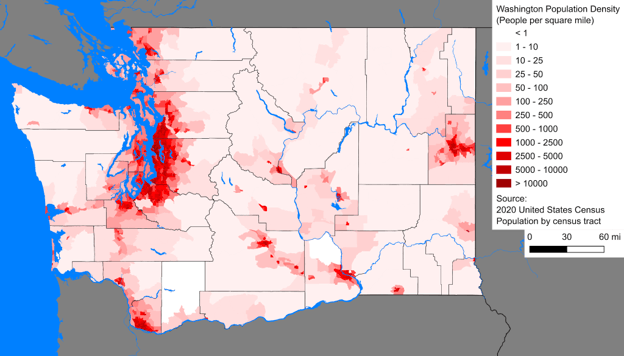
Image: A clean, minimalist architectural blueprint graphic overlaying a crisp outline map of Washington State.
>> SLIDE 4
Shifting the Paradigm: Advocate-Led Discussions
Emergency management structurally crumbles the moment it treats disabled people as a single, uniform block. We are completely flipping the script and shifting the power dynamic. By putting planning authority directly into the hands of grassroots advocates, we replace bureaucratic guesswork with the undeniable reality of lived experience. We aren’t asking for a seat at their table anymore; we are building our own.

Image: Photograph of a diverse group of four business professionals smiling and holding up a large yellow trophy cutout, symbolizing achievement or success. The group is dressed in business attire, standing under a bright, modern architectural structure, highlighting teamwork and celebration.
>> SLIDE 5
Defining the Cross-Disability Spectrum: Everyone Needs Something Different
In the world of emergency preparedness, true “cross-disability” means planning for total variance, not a convenient average. A single crisis event creates entirely conflicting needs across our community—what saves one person could trap another. We must structurally design systems that anticipate absolute differences in communication, mobility, sensory, and medical requirements. If your plan doesn’t account for total variance, it isn’t a plan; it’s a hazard.

Image: Diagram of light dispersion through a triangular prism showing white light entering from the left and splitting into red, green, and blue beams exiting on the right. The prism is outlined in black with a light blue fill, and the separated colors are displayed as distinct colored bands.
>> SLIDE 6
Redefining “Emergency”: Natural vs. Personal Crises
Catastrophes don’t always wait for a headline-grabbing natural disaster to strike an entire city at once. For our community, devastating personal, isolated emergencies happen in silence every single day—a sudden power outage that cuts off life-sustaining equipment, or an agency failure that leaves an individual without a critical personal care provider. Our city and county systems must be architected to withstand both regional disasters and individual, everyday crises.

Image: A stereoscopic VR scene showing numerous floating cubes scattered across a bright, open environment with a glowing light source in the center. The view is split into two nearly identical circular frames with slight chromatic aberration, designed for immersive 3D visualization.
>>SLIDE 7
The SPIL as our Foundation
We refuse to treat the State Plan for Independent Living (SPIL) as a dusty, bureaucratic box-checking exercise. In Washington, we have weaponized the SPIL, transforming it into a rock-solid structural foundation. We use it to legally mandate and aggressively fund advocate-led emergency preparedness initiatives. This ensures our statewide infrastructure is legally bound to protect the cross-disability community through every tier of crisis.
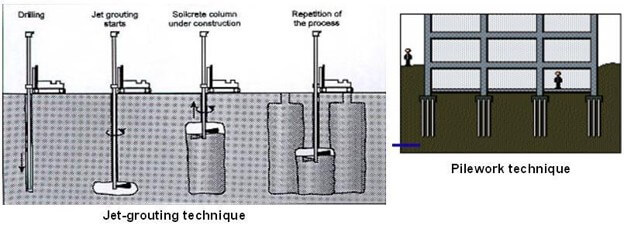
Image: A structural blueprint diagram showing a solid concrete foundation labeled “State Plan for Independent Living (SPIL)” supporting community infrastructure.
>> SLIDE 8
Data to Counties – Mapping Individual Realities
High-level state numbers are too abstract to save lives on the ground. We are driving hard data down to the exact county level, putting undeniable human realities right on the desks of local emergency managers. You cannot plan for needs you refuse to see. By mapping the precise cross-disability demographics of each jurisdiction, we remove ignorance as an excuse and force local coordinators to plan for the actual people who live there.
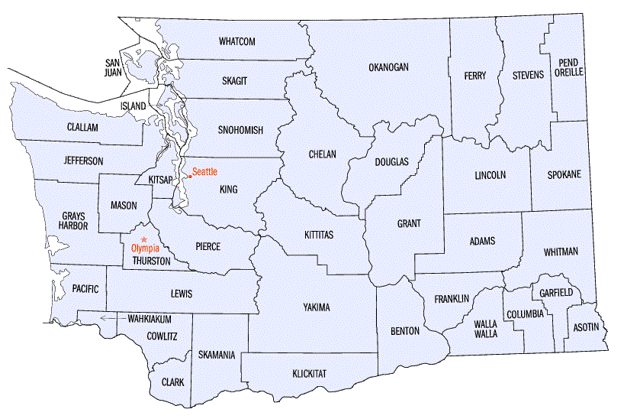
Image: A detailed map of Washington State broken down clearly by individual county jurisdictions and boundaries.
>> SLIDE 9
Self-Preservation: Helping Individuals Map Their Needs
Systemic advocacy is only half the battle; true resilience requires individual empowerment. We are putting the power of self-preservation directly back into the hands of our community members. By providing accessible, deeply customizable toolkits, we assist individuals in auditing their own environments and engineering personal, highly specific emergency blueprints that reflect their exact daily survival needs.

Image: Photograph of a hand holding a white marker and marking checkboxes on a printed checklist sheet placed on a wooden surface. The checklist has multiple empty checkboxes with some already checked, indicating progress or task completion.
>> SLIDE 10
Bridging the Gap: Training First Responders
When chaos hits, communication gaps can be fatal. We are actively bridging the divide from both sides. We give disabled individuals the targeted tools and training to articulate their exact, highly specific needs to personnel under extreme stress. Simultaneously, we are putting our advocates face-to-face with first responders, training them how to listen, slow down, and properly respond to the cross-disability community during an active crisis.
Image: Photograph of three people standing indoors in a lobby area, smiling and posing for the camera. One person in the center holds a blue folder, while a signboard nearby displays text about “WASILC” and encourages voicing opinions on laws.
>> SLIDE 11
Building the Network & Designing for Budget Droughts
Budgets fluctuate, political climates shift, and funding dries up—but emergencies never take a day off. To survive fiscal droughts, we are weaving an unbreakable, lateral, human-to-human web across Washington’s diverse urban and rural landscapes. By directly connecting local advocates and peers, we create a self-sustaining network that shares mutual aid, trades emergency resources, and steps in to ensure an isolated personal crisis doesn’t turn fatal when the system fails.
Image: A resilient network node graphic displaying interconnected, glowing geometric points across a landscape, representing a lateral human-to-human communication web.
>> SLIDE 12
The Top Floor – Executive & Legislative Systems Change
True, permanent resilience cannot survive on grassroots passion alone—it demands top-floor statutory power. We take our localized county data and the undeniable, raw lived experiences of our community directly into the halls of power to reshape state policy. We use real-world stories as political leverage to force systemic changes in executive directives and legislative budget mandates.
Key Advocacy Deliverables
- The Governor’s Office: Securing a permanent, unshakeable seat on the Governor’s Emergency Management Advisory Council (EMAC) to structurally hardwire cross-disability protections directly into state-level disaster response plans.
- State Legislators: Educating and confronting lawmakers on why emergency management is a fundamental, non-negotiable civil rights and independent living issue, keeping the high stakes front and center throughout the legislative session.
- Supporting and Funding CILs: Weaponizing our local data to demand explicit legislative line-item funding for Centers for Independent Living (CILs) to scale up regional emergency programs. CILs are our frontlines, and they cannot protect the community if the state leaves them underfunded.

Image: Flowchart diagram overlaid on a blurred office background showing a hand drawing interconnected rectangular nodes with arrows indicating process flow. The diagram uses black outlines and arrows to represent sequential and branching steps.
>> SLIDE 13
The Blueprint in Action (Statewide Advocacy & Scale)
This is what the blueprint looks like in motion: a fierce, continuous statewide machine. True resilience is not passive waiting; it is an active architecture built from the ground up, honoring the distinct individuality of every single person, and backed by unyielding state-level political power. To our national peers at NCIL: Take this blueprint back to your states. Weaponize your data, solidify your peer networks, demand your line-item funding, and force your way to the executive table.

Image: A unified, circular ecosystem flow graphic showing how localized data, regional networks, CIL infrastructure, and state leadership feedback loops create a cohesive advocacy machine.
>> SLIDE 14
Q&A / Discussion
Presenter Contact Information
Courtney Williams, Executive Director, WASILC
Jim House, Disability/AFN Integration Manager
Washington Statewide Independent Living Council (WASILC)
Let’s design a resilient future together. Thank you.
Image: WASILC logo features a silhouette of Washington state with the acronym “WASILC” in bold white and yellow letters.
Image: National Council on Independent Living logo features a multi-colored fingerprint.
ARCHITECTS OF RESILIENCE: COMPREHENSIVE RESOURCE INDEX
Statutory Plans, Inclusive Networks, and Washington State Disability Data
Part 1: Core State Plans & Legislative Framework
- Washington State Plan for Independent Living (SPIL): The 2025–2027 SPIL establishes Inclusive Emergency Planning as a top three systemic goal, ensuring access and functional needs are central to state emergency response.
- The Rehabilitation Act, Section 704(a): Federal authority requiring comprehensive review, implementation, and public tracking of independent living services on a three-year cycle.
- Administration for Community Living (ACL) Program Regulations: Federal oversight regulations ensuring statutory requirements align with cross-disability equity.
Part 2: Emergency Management & Inclusive Advocacy Networks
- Coalition on Inclusive Emergency Planning (CIEP): A statewide cross-disability coalition hosting program updates, access and functional needs (AFN) assets, and toolkits.
- Center for Independence (CFI) Emergency Preparedness: Training resources and individual planning frameworks mapped directly to the Independent Living Philosophy.
- Federal Emergency Management Agency (FEMA) & Ready.gov: National emergency readiness standards and downloadable multi-modal toolkits curated for individuals with disabilities.
Part 3: Emergency Planning Compliance & Contact Infrastructure
- EPA State Emergency Response Commissions (SERC): Statutory contact directories for cross-agency alignment on hazardous materials and unified emergency planning boundaries.
Part 4: Washington State Demographics & Core Disability Data Hubs
- Cornell University Disability Statistics Nexus: Aggregates U.S. Census Bureau ACS metrics for Washington’s 1.03 million individuals with disabilities, including poverty and labor participation rates.
- DSHS Developmental Disabilities Administration (DDA) Reporting Platform: Tracks active state client caseload profiles and publishes legislative updates regarding state-funded long-term community supports.
- DSHS Research and Data Analysis (RDA) Division: Hosts cross-agency analytical studies, regional trend reports, and deep-dive risk mapping for co-occurring profiles (IDD and mental health diagnoses).
- Washington State Department of Health (DOH) Behavioral Health Data Hub: Compiles epidemiological dashboards tracking adult and youth behavioral trends, anxiety, and depression across counties.
Concurrent Workshops 5: Thursday, July 23; 9:00-10:15 a.m.
5.1 NCD 2027 Policy Projects and Town Hall
- Track: Strengthening Connections — Community and Peer Networks
- Target Audience: Appropriate for all audiences.
- Knowledge Level: Appropriate for all knowledge levels.
- Location: Independence A
The National Council on Disability (NCD), as an independent federal agency, advises the President, Congress, and other federal agencies about issues that are important to people with disabilities. Come learn about the latest topics NCD’s Council Members have selected as new research areas for 2027 and share your experiences and knowledge with NCD about those topics in a town hall format.
Presenters
Amged Soliman is a Senior Attorney-Advisor at the National Council on Disability. He serves as the Staff Lead of NCD’s Health Disparities work, has helped draft legislation that would designate people with I/DD as a medically underserved population, and has also worked in the space of accessible currency, policing and disability rights, and education and disability rights, among others. He is a member of the Maryland State Bar and continues to lecture on the subject of disability rights law and administrative law at various disability conferences nationally.
Joy Levin Welan is a senior attorney advisor at the National Council on Disability. Previously, she served as a deputy chief in the Disability Rights Section of the Civil Rights Division of the U.S. Department of Justice, where she co-led the Section’s regulatory and policy work. Joy joined the Disability Rights Section through the Attorney General’s Honors Program, and worked on ADA regulations, general ADA enforcement, and Olmstead enforcement. She clerked on the Superior Court of the District of Columbia. Joy received her J.D. from Georgetown University Law Center, where she was a Public Interest Law Scholar and served as an editor on The Georgetown Law Journal. She received her B.A. from The George Washington University.
Slide Deck
>> SLIDE 1
National Council on Disability
2027 Policy Projects and Town Hall
Presented by:
Amged Soliman and Joy Welan
Senior Attorney Advisors
National Council on Disability (NCD)
July 23, 2026
>> SLIDE 2
What is the National Council on Disability?
NCD is an independent federal agency.
NCD’s mission is to be a trusted advisor, in collaboration with people with disabilities to:
- The President
- The Congress
- Federal entities
- State, tribal communities, and local governments; and
- Other entities and organizations
>> SLIDE 3
What does NCD do?
Some of the things that the law requires NCD to do are:
- Assess the extent to which policies, programs, practices, and procedures facilitate or impede the promotion of equal opportunity for all individuals with disabilities, and their economic self-sufficiency, independent living, inclusion, and integration into all aspects of society.
- Review and evaluate, on a continuing basis, new and emerging disability policy issues affecting people with disabilities at the federal, state, and local levels and in the private sector.
>> SLIDE 4
How does NCD do its work?
NCD fulfills its advisory roles regarding disability policies, programs, procedures, and practices by:
- Convening stakeholders to acquire timely and relevant input for recommendations and action steps
- Gathering and analyzing data and other information
- Engaging and influencing current debates and agendas with current research
- Identifying and formulating solutions to emerging and long-standing challenges; and providing tools to facilitate effective implementation.
>> SLIDE 5
NCD’s Projects for FY 2027
- Medicaid and Home and Community-Based Services Portability
- Artificial Intelligence (AI)
- Assisted Suicide
>> SLIDE 6
Medicaid Portability – Part 1
- Examining systemic barriers caused by the lack of interstate portability within Medicaid and Home and Community-Based Services (HCBS) programs
- Considering the burden of re-establishing disability eligibility when moving between states—even if the disability is lifelong and medically documented
- Looking at how state-by-state eligibility decisions, waiting lists, and re-certification requirements limit mobility, employment opportunities, and family stability for Americans with disabilities.
- >> SLIDE 7
Medicaid Portability – Part 2
- Our goal is to highlight the economic and human effects of these policies, evaluate the roles of federal and state policies that contribute to fragmentation, and suggest policy solutions to enable individuals with disabilities to move, work, and live across state lines without losing access to essential supports.
- We want to identify the main systemic barriers preventing states from adopting interstate portability for HCBS programs and suggest ways federal policies can help remove them.
Thoughts or stories you want to share?
Things we should know?
>> SLIDE 8
Artificial Intelligence – Part 1
- AI and other technology have the potential to reduce accessibility barriers and improve the lives of people with disabilities. However, to do so, they must be developed and implemented with care to ensure accessibility and nondiscrimination.
- One goal is to warn policymakers about the susceptibility of AI to learn or develop biases and misconceptions about the abilities of people with disabilities, which could significantly undermine decision-making processes.
- This can have implications for employment, healthcare, and many other areas.
>> SLIDE 9
Artificial Intelligence – Part 2
- We want to advise policymakers about needed legislative or regulatory guardrails on the development of AI to prevent discrimination against people with disabilities.
- We also want to investigate whether AI can help address the shortage of direct care workers by taking over some routine tasks, which might free up some workers to focus on hands-on personal care.
Thoughts or stories you want to share?
Things we should know?
>> SLIDE 10
Assisted Suicide – Part 1
- NCD has opposed assisted suicide laws since 1997, when NCD conducted an in-depth examination of the issue.
- Biased assumptions in healthcare often form the basis of life and death decisions.
- These laws can create a two-tiered system that results in death to people with disabilities, who are socially devalued and thought to have lower quality of life, while ignoring the social determinants of health and well-being (like a lack of HCBS) that can influence people with disabilities to experience situational hopelessness or despair.
>> SLIDE 11
Assisted Suicide – Part 2
- Since NCD’s most recent 2019 report on this issue, six states have legalized assisted suicide, while other states and Canada are expanding their laws.
- We plan to look at the consequences of expansion and any lessons that can be learned.
- We also plan to examine whether people with disabilities remain uniquely vulnerable in the legalized assisted suicide framework in the U.S., and if meaningful choice exists for people with disabilities.
>> SLIDE 12
Assisted Suicide – Part 3
Thoughts or stories you want to share?
Things we should know?
Image: From the cover of NCD’s 2019 assisted suicide report. An African-American man is sitting in a wheelchair next to a bed. An African-American female nurse wearing scrubs is sitting next to him on the bed. The report title, “The Danger of Assisted Suicide Laws: Part of the Bioethics and Disability Series” is on the right, above the NCD logo. Below the logo it says “National Council on Disability, October 9, 2019”
>> SLIDE 13
NCD’s Strategic Plan
Under Construction!

Image: Yellow triangular road sign showing the symbol for construction – a stick figure digging.
What should we include?
>> SLIDE 14
Open Public Comment Period
Image: NCD logo – an eagle inside a circle that says National Council on Disability around the edge.
What do you want NCD to know?
>> SLIDE 15
Contact Information
Amged Soliman: asoliman@ncd.gov
Joy Welan: jwelan@ncd.gov
Phone: 202-272-2004
Image: NCD logo – an eagle inside a circle that says National Council on Disability around the edge
Concurrent Workshops 6: Thursday, July 23; 10:30-11:45 a.m.
6.1 Assisted Suicide Panel
- Track: Advocacy in Action
- Target Audience: Appropriate for all audiences.
- Knowledge Level: Appropriate for all knowledge levels.
- Location: Independence A
In a time of Medicaid cuts and widespread ableism, people with disabilities are increasingly being labeled as “terminal” under assisted suicide laws — not because of their conditions, but due to systemic barriers that deny access to essential care, services, and community-based supports. For decades, the disability community — especially leaders within the Independent Living movement — have been at the forefront of opposing these laws, highlighting the risks they pose to disabled people’s autonomy, safety, and dignity.
This panel will explore the core reasons behind this opposition, examine the current landscape of these laws and their real-world consequences, and provide practical guidance for advocates in the independent living movement. Participants will learn how to protect themselves and their communities from the harms of these policies, and how to actively engage in advocacy efforts aimed at challenging and ultimately abolishing these discriminatory laws.
Presenters
Jessica Rodgers, is the Coalitions Director for the Patients Rights Action Fund (PRAF), a national, secular, non-partisan leader defending the rights of patients, people with disabilities, our elders, and the poor from the threat of legalized assisted suicide. PRAF is a 501(c)(4) not-for-profit corporation. With personal experience as a caregiver in a state with legal assisted suicide, she has seen firsthand how these laws undermine the doctor-patient relationship. Jessica has a long history of non-profit advocacy, most recently running a program for college students with disabilities. She holds a Master of Social Work Degree with a concentration in gerontology and lives in Albany, NY.
Theo Braddy is the Executive Director of the National Council on Independent Living (NCIL), a role he assumed in 2023 after more than three decades of leadership in disability advocacy. He previously served as CEO of the Center for Independent Living of Central Pennsylvania (CILCP), where he helped pioneer the concept of “Living Well with a Disability,” built inclusive community resources, and played a key role in advancing accessible transportation and Medicaid waiver services in Pennsylvania. Braddy’s journey began with personal adversity — living in a nursing home as a teenager after a spinal cord injury — but he transformed that experience into a lifelong mission to challenge ableism and promote independence for people with disabilities.
Ian McIntosh is the Executive Director of Not Dead Yet (NDY), a national grassroots disability rights group opposed to the legalization of assisted suicide and euthanasia as deadly forms of disability discrimination. Prior to his time at NDY, Ian served as Director of Disability Outreach at the Patients Rights Action Fund, a national, coalitions-based organization fighting against the legalization of assisted suicide. In addition to his personal experiences with disability, Ian’s interest in marshaling coalition-based opposition to disability discrimination is informed by his history with union organizing in his native Ontario, Canada.
Horacio Esparza has worked for Progress Center since 1999 and has served as Executive Director since 2008. Horacio was born in Zacatecas, Mexico. He lost his vision at the age of seven, but his activism began the very next day, after leaving the hospital. Thoughts of death never once crossed his mind. Horacio recalls hearing his mother say one day, “I would not want to die before Horacio and leave him unprotected.” Upon hearing those words, he replied, “And why should I die first, Mom?” From that moment on, his parents worked tirelessly to provide him with all the tools necessary to achieve an independent life. His parents departed this earthly life satisfied and proud to see their son become self-sufficient — just as all individuals with disabilities should have the opportunity and support to become.
Sebastian Nalls is the Healthcare and Home and Community-Based Services (HCBS) Policy Analyst at Access Living, where he works on disability rights, Medicaid, healthcare, and community-based care policy in Illinois. He previously worked in the Office of Equity under the administration of JB Pritzker and was a candidate for public office in 2021. Sebastian graduated from Purdue University in 2022 and is currently pursuing a Master of Public Policy at Northwestern University.
Clifton (“Cliff”) Perez of Troy, New York has advocated for disability rights since 1985. He holds a master’s degree in social work from Stony Brook and serves as Systems Advocate at the Independent Living Center of Hudson Valley. Nationally, he has held key leadership roles with the National Council on Independent Living (NCIL), including Vice President, Region II Representative, and Co-Chair of NCIL’s Transportation Subcommittee. He also represented NCIL on the U.S. Access Board’s Railroad & Vehicle Accessibility Advisory Committee. Perez has held numerous state leadership roles, including board member of New York State Independent Living Council (NYSILC) and representative to the NY State Rehabilitation Council. His honors include induction into NYSILC’s Disability Rights Hall of Fame, Hudson Valley Community College Outstanding Alumni Award, and NCIL’s 2024 Max Starkloff Lifetime Achievement Award.
6.2 Advocacy: From Barriers to Breakthrough
- Track: Advocacy in Action
- Target Audience: Appropriate for all audiences.
- Knowledge Level: Appropriate for all knowledge levels.
- Location: Lafayette / Farragut
A 3-part interactive working space that allows participants to understand the complexity of advocacy, understand systematic barriers in Independent Living, and reflect on how protecting rights, persisting through challenges, and creating prosperity requires strategy, resources, and collaboration.
Presenters
Brittany Stuckey is a mission-motivated disability advocate with strong ties to her community, more specifically Ward 8 of Washington, D.C. Ms. Stuckey holds a degree in Mass Communications with a minor in Sociology and is a Master of Social Work / Doctor of Social Work candidate focused on macro and mezzo work. She is committed to building strong networks and partnerships, disability empowerment and advocacy in youth, and continuing evidence-based programming to further positive outcomes in the community. She has been a pivotal partner in increasing ADA accommodations in education spaces and has developed internship opportunities, a sighted-guide field trip series, and a host of other ventures to increase awareness, social interaction, and education in the disability community.
LaKenya Pitchford has had a passion for Human Services in her heart for years. LaKenya was diagnosed with Stargardt disease as a teenager, which affects her central vision. As a person with a visual impairment, LaKenya did not let her limitations stop her from reaching her goals and ambitions. During her journey in Human Services, she has accomplished a Bachelor’s Degree in Mass Communication, a Master’s Degree in Assistive Technology Studies and Human Services, and certificates in Case Management and Human Services. LaKenya has worked in the disability community in several capacities, including advocate, Independent Living Specialist, facilitator / trainer, and Assistive Technology Assessment Specialist. To effectively serve people with disabilities, LaKenya became a Certified ADA Coordinator and Certified Mental Health First Aid Instructor. LaKenya is an Independent Living Specialist at the DC Center for Independent Living and desires to continue supporting, encouraging, assisting, and informing individuals with disabilities. She also continues to educate the community on disability etiquette and awareness related to interacting with individuals with disabilities and the ADA. LaKenya is enthusiastic about her future in disability service.
Slide Deck
>> SLIDE 1
Advocacy: From Barriers to Breakthroughs
Systemic approaches to Choice, Control and Community.
Presented by:
Brittany Stuckey
Lakenya Pitchford
>> SLIDE 2
Say “Hey Neighbor”
- Everyone greet your neighbor, (please describe yourself and share where you are from or anything other relevant information.)
Icebreaker: What is your advocacy superpower? Share with your group or neighbor.
- Volunteers feel free to share with the collective.
>> SLIDE 3
Rules of Engagement
Every group must move through 3 stages, Protect, Persist and Prosper while encountering real world barriers that we, as advocates face. There will be a community issue, barrier card and resource tokens which will determine the group’s path. Some groups will receive power cards to outline inequities in advocacy.
- Group members will collaborate to produce solutions to overcome the barriers.
- The group will choose a note taker or utilize a rotate model.
>> SLIDE 4
Structural Framework of Advocacy
Protect- Defending established civil and human rights from regulatoryrollbackand systemic dilution.
Persist- Maintaing tactical momentum under structural resistance and resource scarcity through strategic partnership
Prosper- Designing and implementing long-term sustainable community solutions that foster absolute self determination.
>> SLIDE 5
Inequity and Team Dynamics in Collaborative Spaces
- Systemic privilege, utilizing power cards to model structural resource imbalances that exist in advocacy.
- Integrating mixed levels of expertise and organizational roles. Pair seasoned staff with frontline staff to ensure experience guides policy.
>> SLIDE 6
Group 1
Community Issue: Housing Inequity
Barrier:
- Burnout
- Policy delays
Resource Token: New Staff
Power Card: Media attention
>> SLIDE 7
Group 2
Community Issue: Education funding
Barrier:
- Misinformation
- Volunteer burnout
Resource Token: Time
>> SLIDE 8
Group 3
Community Issue: Environmental Protection issues (i.e., clean water)
Barrier:
- New Administration
- Opposition group mobilizes
Resource Token: Money
Power Card: Grassroots Movement Surge
>> SLIDE 9
Group 4
Community Issue: Healthcare Access
Barrier:
- Community distrust due to past failures
- Opposition Lobbying
Resource Token: Money
>> SLIDE 10
Group 5
Community Issue: Food Desert
Barrier:
- Awareness
- Funding cuts
Resource Token: Money
Power Card: Celebrity Endorsement
>> SLIDE 11
Advocacy Action Plan Template
Goal/Questions to think about critically
My Plan
- Issue I am advocating for?
- Why does it matter?
- Who is affected?
- Decision Maker(s)
- Allies and Partners?
- My advocacy message. (30) seconds
- First Action to take?
- Timeline
- How will I measure success?
>> SLIDE 12
Coalition Building Toolkit – Strong Coalitions create strong change.
Who should be at the table? Be imaginative.
- Centers for Independent Living
- People across disability
- Family Members
- Aging organizations
- Veterans Organizatioons
- Mental Health Organizations
- Transportation agencies
- State and local policynakers
- Housing Partners etc.
- >> SLIDE 13
Coalition Toolkit 2
Tip Jar
- Lead with shared goals and not organizational agendas.
- Center lived experience while applying quantitave evidence.
- Give everyone a meaningful role that centers their strengths.
- Use SMART (specific, measurable, achievable, relevant, and time bound) goals to track progress.
- Celebrate small wins.
- Stay connected once shared goals are accomplished.
- The most impactful coalitions are built across sectors, generations, and lived experience. Build cross generational cohorts.
- Use what is at your disposal. No form of advocacy is too small.
>> SLIDE 14
DRAW A BARRIER CARD
Protect
Each group must protect existing rights or services from being weakened while fighting to expand them.
Choose one advocacy Action:
1. Meet with Lawmakers
2. Organize Community Members
3. Run a Public Awareness Campaign
4. File Legal Action
>> SLIDE 15
Reflection:
What made protecting existing rights difficult?
>> SLIDE 16
Persist
DRAW ANOTHER BARRIER CARD
Groups Must:
- Adapt a strategy.
- Use a resource token.
- Possibly partner with another group.
>> SLIDE 17
Reflection:
What helped you keep going when the process became difficult?
>> SLIDE 18
Prosper
Groups design a solution that helps the community long-term (i.e):
- Policy change.
- New Programming.
- Coalition Building.
- Economic Investment.
>> SLIDE 19
Reflection:
Which stage was the hardest? Protect, Persist or Prosper?
Who tends to face the biggestt barriers in advocacy?
What resources make advocacy more successful?
>> SLIDE 20
HUDDLE
“Nothing About Us Without Us” ensures that we are the architects of the sytems and policies that impact us. Within that we must be mindful that we are caring for our bodies and minds through strategic rest.
We must also build strong mentorship circles so that intergenerational cohorts can carry and lead this movement.
Qualitative Data sharing is a huge part of awareness; please share your stories. You never know who you may reach.
>> SLIDE 21
HUDDLE 2
Know your rights! Try to stay current on policy changes and organizations that can assist in your ability to advocacte for yourself and others.
Always know that community is at your fingertips. The ability to build coalitions, engage in community-based partnerships and accessing support is the backbone to coalition building.
>> SLIDE 22
THANK YOU FOR ATTENDING; We look forward to continuing this work with you all!
>> SLIDE 23
Presenters Contact Information:
Brittany Stuckey
bstuckey@dccil.org; mobile: (202) 599-4897
Lakenya Pitchford
Lpitchford@dccil.org; office (202) 388-0033